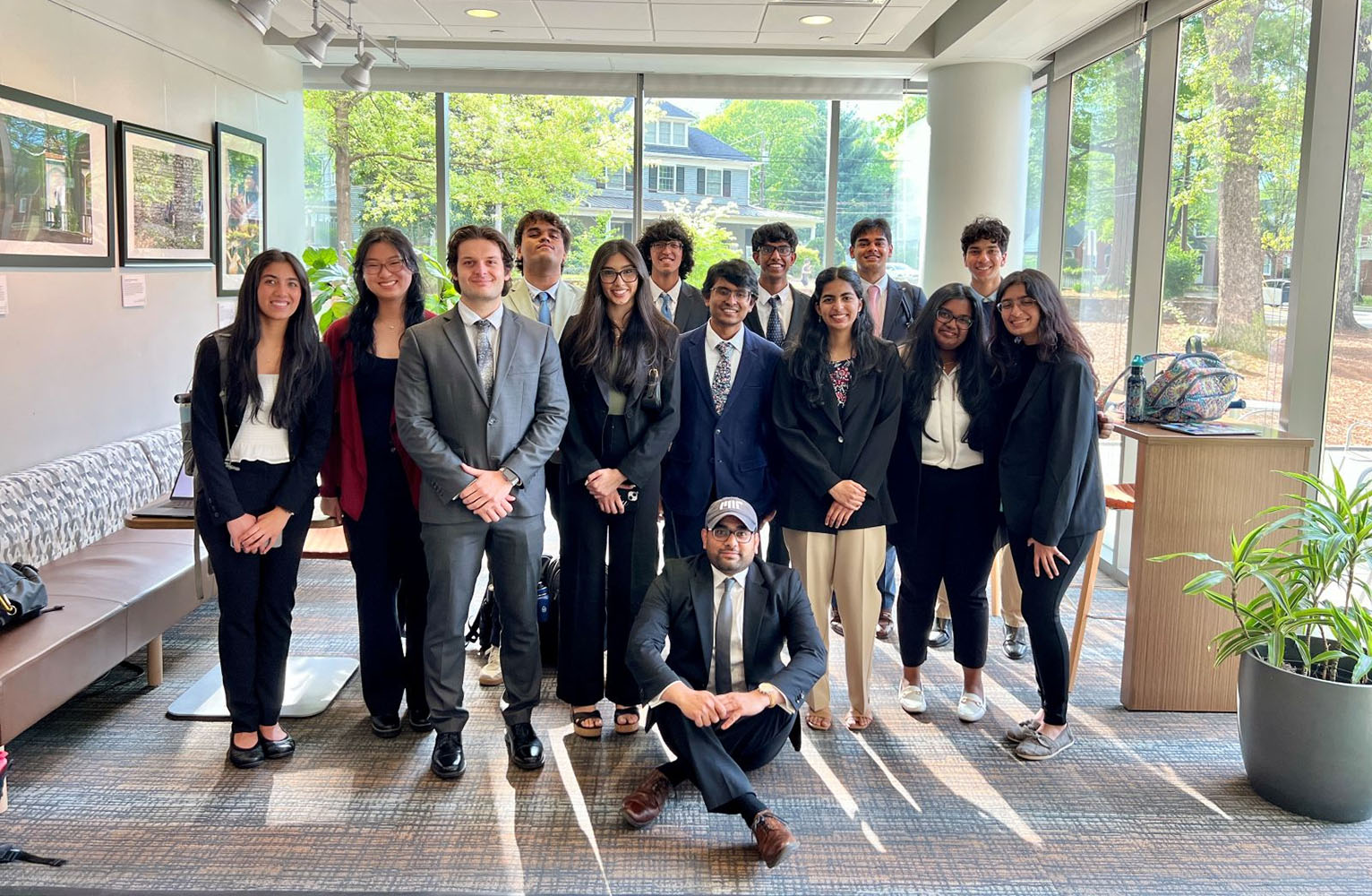
Neil Gaikwad (sitting) and Diplomacy Lab students (submitted photo)
Working with federal agencies, Diplomacy Lab students analyze global challenges such as water conflict and Arctic security; donor funding powers record participation.
By Logan Ward
Talk about disappointment. After Annabelle Gallinek ’26 landed a dream internship combining her interests in diplomacy and public health at the U.S. State Department, she learned five months later, in April 2025, that it was canceled due to federal hiring freezes.
“I was very upset for a week,” says Gallinek, a senior in the Health Policy and Management program at the UNC Gillings School of Global Public Health. “And then I thought, I’m not going to let this be the end of my story with the Department of State.”
Donor funding helped revive Gallinek’s State Department dream, leading to the highlight of her undergraduate experience.
Here’s how: The same week Gallinek learned of her canceled internship, the State Department issued its Diplomacy Lab projects. Through the Diplomacy Lab, students from more than 60 colleges and universities were competing for the opportunity to analyze real foreign policy challenges and work directly with diplomats and policymakers to solve them.
Gallinek and three fellow students chose a project to control a fast-growing HIV epidemic in Fiji, but they needed a faculty adviser. UNC School of Medicine Assistant Professor Dr. Sarah Rutstein agreed to help. UNC Global Affairs kicked in a $2,500 curriculum development award, drawn from its philanthropic Global Education Fund, to help make Rutstein’s involvement possible.
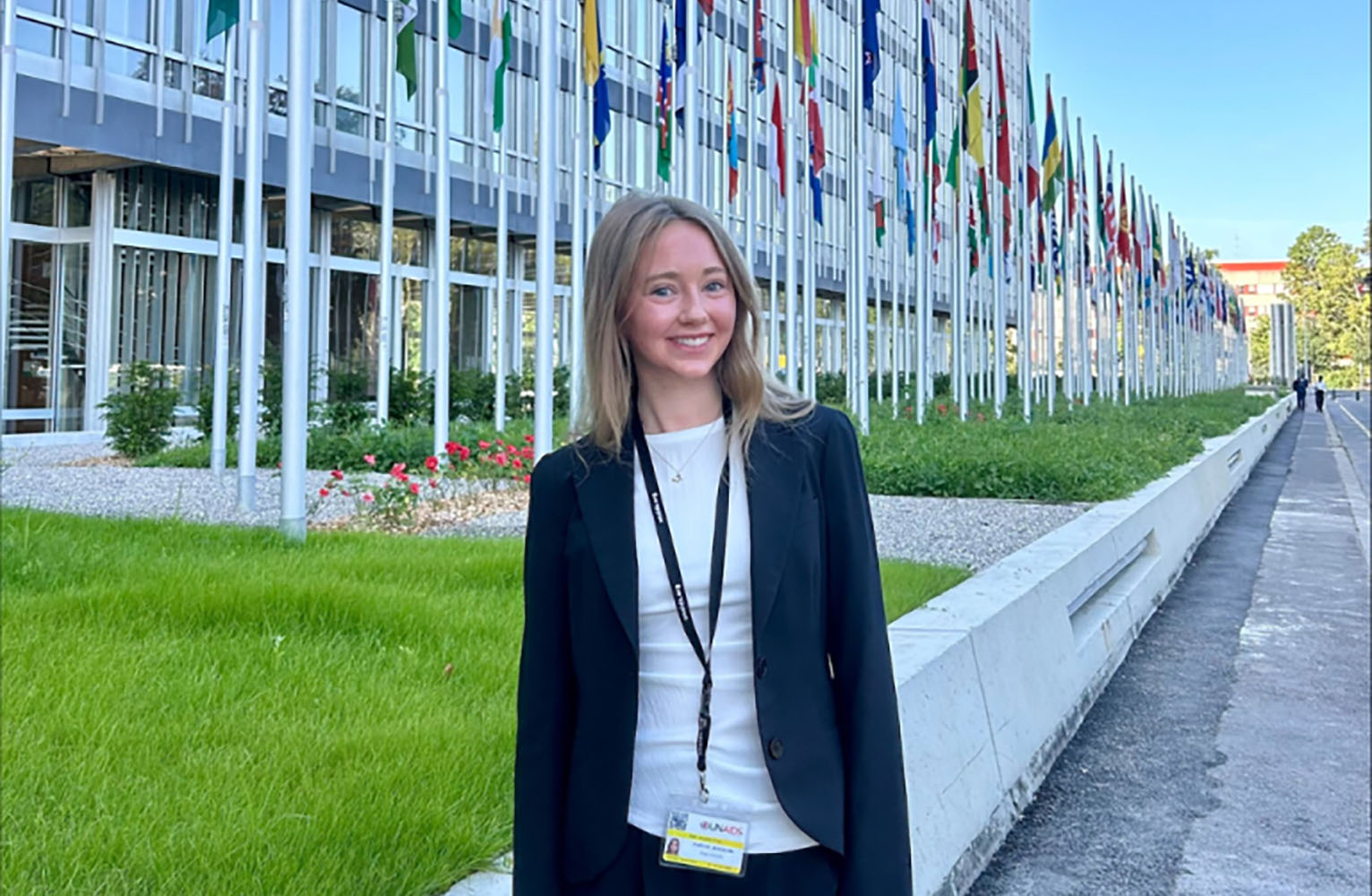
Annabelle Gallinek ’26 at the World Health Organization headquarters in Geneva, where she attended a UNAIDS board meeting, which inspired her team’s Diplomacy Lab project addressing the HIV outbreak in Fiji. (Submitted photo)
“The curriculum development award is a small but meaningful incentive for faculty,” said Sharmila Udyavar, UNC Global Affairs associate director for global education, who oversees the Diplomacy Lab program. “The money we give them goes a long way to ensure that students have these opportunities, because none of these projects can be done without a faculty mentor.”
Universities that do not offer similar faculty awards struggle to get participation, according to benchmarking done by Udyavar’s office. By contrast, in 2025 Carolina won a record number of projects — five in the spring and nine in the fall. In all, more than a dozen faculty have received Diplomacy Lab curriculum development awards.
Gallinek’s team won its bid and spent a semester researching the HIV epidemic in Fiji. In meetings with State Department and UNAIDS officials, the students made policy recommendations to strengthen diagnostic testing, improve linkage to care and reduce mother-to-child transmission.
“The Diplomacy Lab is the coolest thing in the entire world,” Gallinek said. “It feels like the culmination of all my experience. It made me realize this is exactly what I want to do as a career.”
Rising temperatures, cooling cooperation
For Jakob Wiedekind, German Academic Exchange Service visiting assistant professor of political science in the UNC College of Arts and Sciences, winning a Diplomacy Lab project was the perfect way to enhance the student experience in his high-level European Union foreign policy class.
The team’s topic? Improving U.S.–EU cooperation on Arctic security as Russia and China increasingly muscle into the region. Further complicating the issue are fast-rising Arctic temperatures and cooling U.S.–EU cooperation.
Wiedekind’s students worked with the National Foreign Affairs Training Center (NFATC) to understand and analyze the region’s evolving geopolitical dynamics. They presented detailed policy recommendations to “advance U.S. strategic autonomy and defense postures, reduce costs through allied burden-sharing and strengthen U.S. economic leverage.”
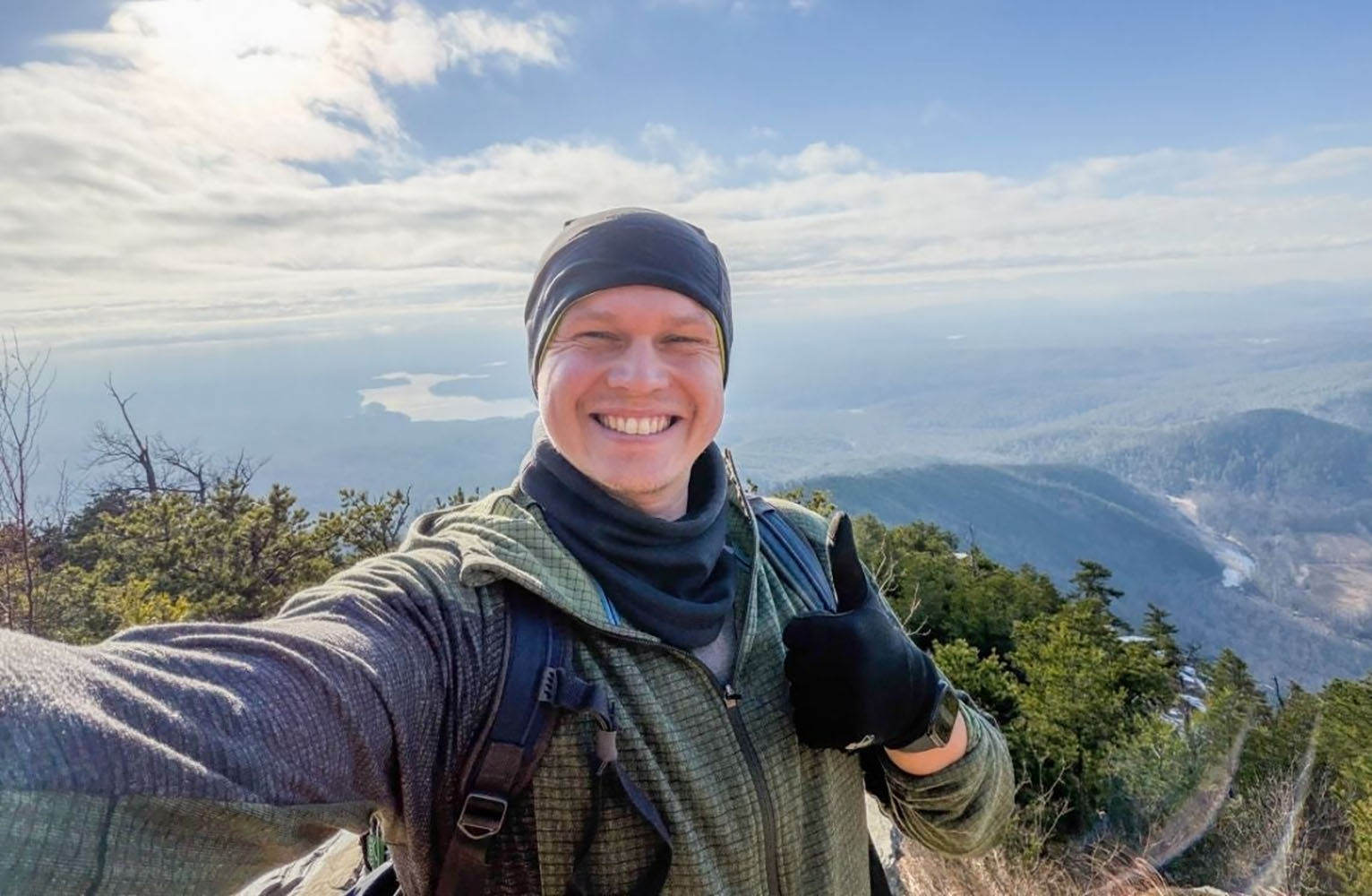
Jakob Wiedekind, German Academic Exchange Service visiting assistant professor of political science, strengthens ties among UNC-Chapel Hill and German institutions while exploring the beauty of North Carolina in his free time. (Submitted photo)
Their initial presentation wowed the NFATC officials. “They said, ‘There’s so much credible and well-researched policy guidance here that we need to bring other people in to listen to this,’” Wiedekind said. Among the other people was the head of the Bureau of Arctic Policy.
“The students were shocked. It wasn’t just that they presented to these diplomats. They had a chance to ask the diplomats questions. The students’ eyes were almost glowing with excitement,” said Wiedekind. “It’s not exaggeration to say this experience was life-changing for these students.”
The curriculum development award made a big difference, Wiedekind said. It helped in three main ways: 1) giving him a financial incentive, 2) enabling him to hire research support and 3) demonstrating his ability to bring in funds to support his teaching.
“It’s donor money well-spent because it immediately benefits the students,” he said.
Fresh perspectives
A key State Department Diplomacy Lab goal is to harness “the expertise and fresh perspectives of students and faculty members.” When it comes to using artificial intelligence to analyze data, Carolina students have much to offer, said UNC School of Data Science and Society Assistant Professor Neil Gaikwad, founding director of the Society-Centered AI Lab.
“My students have very different ways of thinking about AI and social good. They are trained technically. They can speak the language of AI scientists, but they can also speak the language of policy makers,” said Gaikwad, who has advised multiple Diplomacy Lab teams. “The diplomats benefit because whatever recommendations the students make are science-backed.”
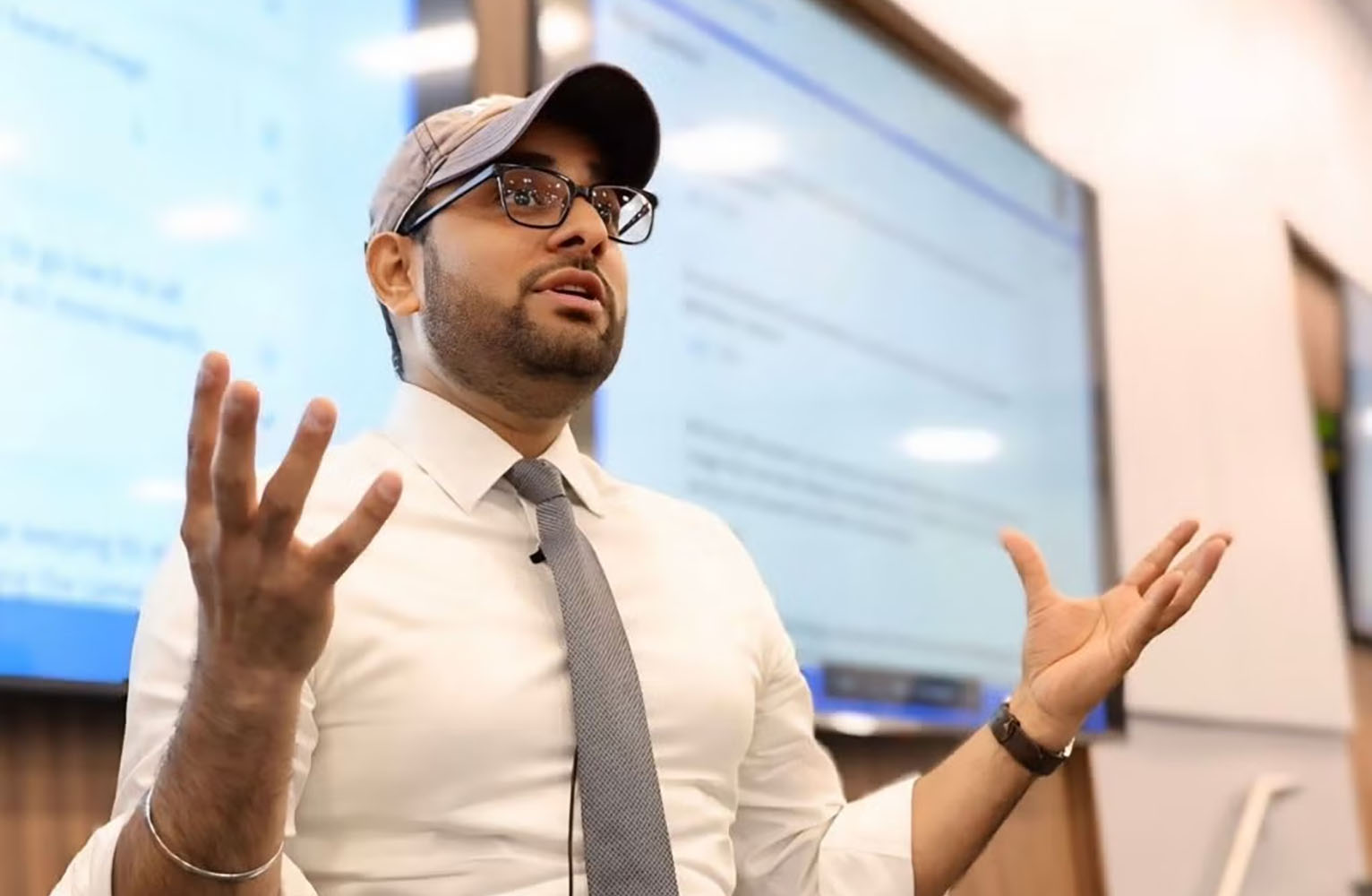
UNC School of Data Science and Society Assistant Professor Neil Gaikwad is the founding director of the Society-Centered AI Lab. (Submitted photo)
In spring of 2025, Gaikwad mentored two Diplomacy Lab teams, one that used AI to investigate global human rights trends and another that analyzed water usage in Nuevo Laredo, Mexico. Then, in the fall, he led three teams. One researched how to harness AI to gain ecological knowledge about biodiversity in Southeast Asia. Another focused on creating equitable labor platforms in Mexico and California. The third, still ongoing, explores how to use AI and remote sensing data from NASA satellites to solve problems such as illegal fishing and food insecurity in Association of Southeast Asian Nations (ASEAN) countries.
“AI is getting used in many sectors, but not many universities are thinking about using it methodologically in the public sector. That’s the primary focus of my research group. How do we design it and then use it responsibly for solving societal problems? Having financial support from UNC Global Affairs is important validation for this work,” he said.
“The main goal is to bring these opportunities to students,” said Udyavar from UNC Global Affairs. “There is a really big appetite for this among the students. Freshmen come to us saying, ‘How can I be a part of the Diplomacy Lab?’ They are keen to get into this space. They want to do this work.”
Gaikwad understands why. “The opportunity to work on real problems with real diplomats goes beyond what they learn in the classroom,” he said. “That’s really powerful.”