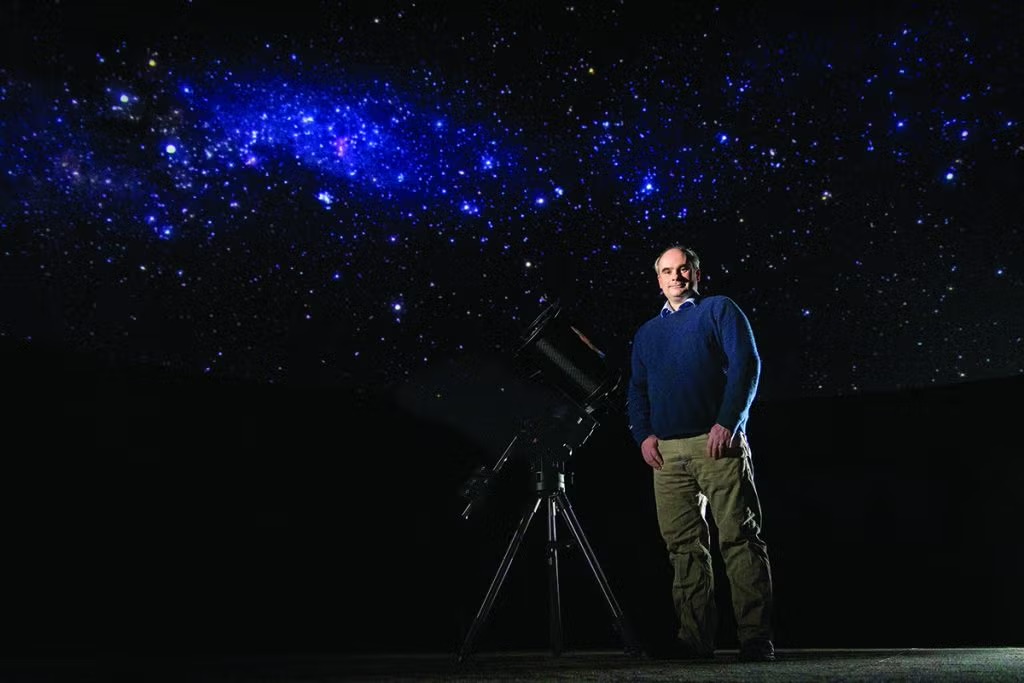
Nicholas Law, head of the Argus Array project, poses with an Argus Array telescope beneath the Milky Way projected onto the dome of the Morehead Planetarium and Science Center. (Photo by Megan Mendenhall/UNC Research.)
Astronomer Nicholas Law can’t remember a time when he wasn’t fascinated by space. Now, he’s building a telescope that can probe the cosmos with unprecedented detail.
In the mountains of Chile and California, twin telescope systems work together to capture the entire night sky every two minutes.
These EvryScopes — Greek for “wide-seeing”— look like massive white helmets, each with 27 windows through which individual telescopes peer at different pieces of the sky. Their project lead, Nicholas Law, has used the EvryScopes to search for new planets outside our solar system and even to assess their habitability.
Law, a professor of physics and astronomy at UNC-Chapel Hill, fondly remembers a gift from his childhood that kindled his interest in distant planets.
“My parents gave me a book. It had these amazing paintings of what it would be like to stand on the surface of a planet around another star or in another galaxy,” Law recalls. “Those paintings were so evocative, they really caught my imagination. I always wanted to explore what those distant planets might be like.”
While those EvryScopes have made progress toward that childhood goal, they really serve as a stepping stone to a much larger project. Thanks to a commitment from Schmidt Sciences and Alex Gerko, founder of XTX Markets, Law is now leading the construction of the Argus Array, which, once completed, will be the world’s largest and most powerful telescope survey system to date.
The Argus Array will create the first full-time, high-resolution video of the entire Northern sky — enabling the visualization of fleeting events that other telescopes can’t capture — and will make the data publicly available to be used by astronomers worldwide. The unprecedented amount of information the Array will produce could truly revolutionize the way we study the cosmos.
A parallel passion for computers
Law’s interest in space and astronomy likely predates his book of planetary paintings. He recalls pictures of himself pointing and staring at the sky at the age of 3 or 4.
“I honestly don’t remember how that interest started, because it was so early on,” he said.
He can, however, pinpoint the catalyst that drove his childhood fascination toward a viable career path: an interest in computers.
“I spent a lot of time as a kid playing with computers, trying to squeeze the maximum amount of performance out of them that I could,” Law said. “In my career, I’ve followed that same drive to get the best performance out of the hardware.”
Law followed his passion to a Ph.D. program at the University of Cambridge, then to postdoctoral positions at the California Institute of Technology and the University of Toronto, where he became involved in projects designed to survey the sky for fleeting astronomical events known as transients. While at Toronto, he set up a telescope near the North Pole and used the pole’s winter months of constant darkness to monitor the stars continuously, which normally requires a telescope in space. Although the camera captured only a small piece of sky, it generated impressive data.
In his perpetual quest to push the limits of scientific discovery, Law wondered what kind of data a bundle of such telescopes could produce.
This question brought him to Carolina in 2013 and to the EvryScopes, but he wasn’t finished scaling up. If a system of 27 small telescopes was successful, why not a system of hundreds of much larger ones?
A design born of necessity
Law named the Argus Array after a subspace telescope featured in an episode of Star Trek: The Next Generation. Its original design resembled a much larger EvryScope — a massive fiberglass dome with telescopes peering out though hundreds of windows. Law and his team prepared to build the prototype in 2020, but the COVID-19 pandemic threw a wrench into their plans.
“We couldn’t find a single fiberglass manufacturer anywhere in the world capable of making the pieces we needed,” Law said, despite having had three manufacturers lined up six months prior. “I went back to the drawing board and tried to figure out if there was a way to build the system without the large dome component.”
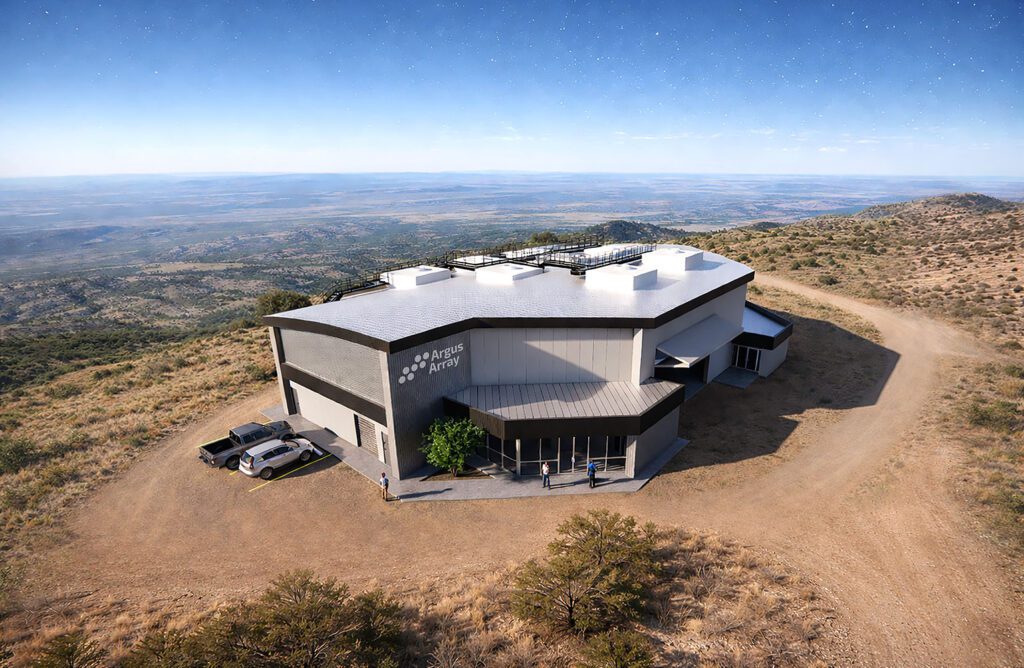
Artist’s rendering of the planned Argus Array complex in the mountains of southwest Texas, where a dark sky will allow for clear pictures of the cosmos. (Photo courtesy of Schmidt Sciences.)
Law realized that he could decrease the number of windows from hundreds to just one by turning the design inside out. Instead of pointing outward from a dome, each scope would point into the middle of a bowl.
“If all the telescopes point inwards, they can look through a single window,” Law said. “That turns the enclosure into something any contractor can build — essentially, a building with a skylight.”
The National Science Foundation funded the development of Argus Pathfinder, a 38-scope prototype that allowed Law’s team to fine-tune their new “pseudofocal concept” and demonstrate its performance.
That’s when Schmidt Sciences took notice.
They picked up the Argus Array project as part of the Eric and Wendy Schmidt Observatory System, a network of one space and three ground telescopes that may revolutionize the collection of astronomical data. Last year, to take advantage of new sensor technology that emerged in early 2025, Schmidt Sciences expanded its funding, and Gerko came onboard as a co-funder, effectively doubling the size of the Array. Argus will now feature a total of 1,200 telescopes. The system will be equipped to capture a continuous, 122-gigapixel movie of the entire Northern sky — 35 times more pixels than the previous largest digital camera.
While the EvryScopes take a picture every two minutes, the Argus Array will take pictures a hundred times faster.
“We’ll be able to make unique discoveries simply because we’re looking everywhere at once,” Law said. “We can detect things when other telescopes have to look elsewhere.”
The promise of a powerhouse
What could such unprecedented power help astronomers explore?
One possibility is the earliest stages of supernovae, the explosive deaths of stars that are rarely observed from the beginning. Because Argus will be scanning the sky continuously, it is far more likely to capture the full event and what led to it.
“We can look back at the days and hours before — almost like a time machine — to see what’s happened in the sky,” Law said.
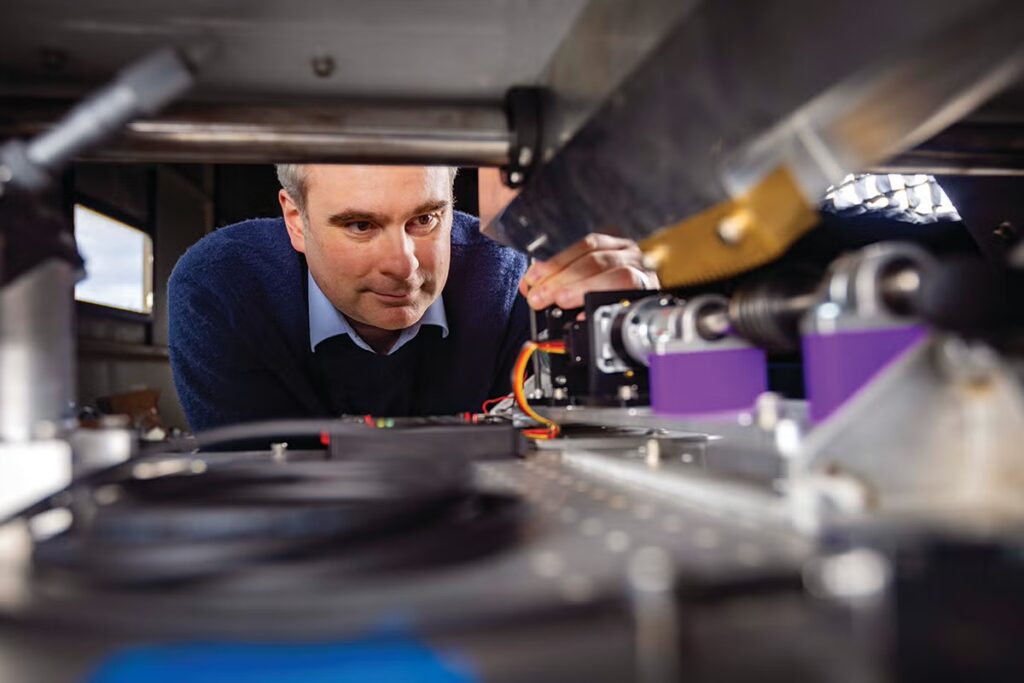
Clusters of Argus Array telescopes will be mounted on machinery that will move and rotate the telescopes to capture the full night sky. Prototypes like this one Law is working on help the team fine-tune the mechanics. (Photo by Megan Mendenhall/UNC Research.)
Another application is the search for new planets, both near and far. Law explained that astronomers often find new planets via a phenomenon called microlensing, in which the gravity of a planet bends the light from its star as it passes, making the star appear many times brighter. Current projects focus their scopes on a distant region of the Milky Way, where they can watch more stars at once. Because Argus doesn’t have to choose where to look, it may identify planets all over the sky, including ones much closer to home.
But Law emphasized that the true power of the Argus Array lies in its unlimited possibilities. Researchers around the world are already preparing to use its data for a variety of projects.
And they’ll be able to. All data from the Argus Array will rapidly be made publicly available.
“Within the first few weeks of operation, Argus will collect more data than all optical telescopes that have ever existed across their combined lifetimes,” Law said, noting that a data center built alongside the array will use AI to process the approximately 8,000 terabytes collected per night. Law explained that at “first light,” when the Array is turned on, the project will just be beginning as graduate students, postdoctoral fellows and software engineers start to analyze the data.
The design, prototyping and construction process have already provided valuable experiences for students and postdocs at Carolina. Law expressed gratitude for the dozens of people at UNC-Chapel Hill and around the world working to make this project happen, including survey scientist Hank Corbett and program manager Alan Vasquez Soto.
Construction on the Argus Array is expected to finish in the mountains of Texas in 2027. Law can then watch the night sky through a computer screen — but with no less fascination than when he pointed to it as a child.
“These sorts of systems allow us to do science that’s impossible any other way,” he said. “A lot of what makes this telescope work didn’t exist when we started. Now it does, and we can’t wait to bring Argus data to the world.”
Learn more about the Argus Array.
Funded by Schmidt Sciences and Alex Gerko, the Argus Array will enable real-time discovery across the universe in unprecedented detail with open access for all.
By Calley Jones, The College of Arts and Sciences