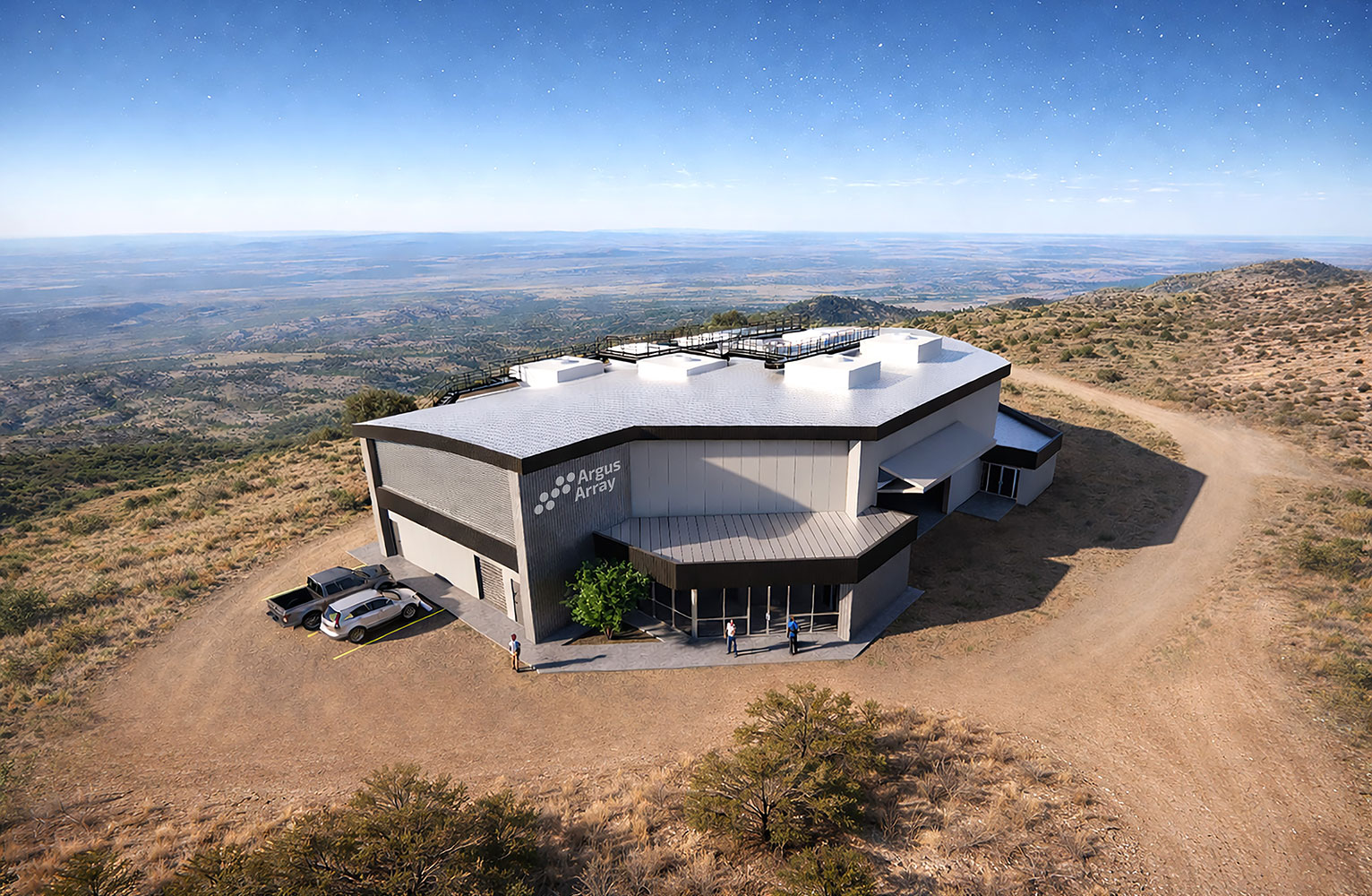
Conceptual rendering of the Argus Array
Funded by Schmidt Sciences and Alex Gerko, the Argus Array will enable real-time discovery across the universe in unprecedented detail with open access for all.
The University of North Carolina at Chapel Hill is embarking on a bold new era of astronomical discovery with the construction of the Argus Array, a revolutionary telescope system that will be the first large telescope capable of observing the entire Northern nighttime sky at once and identifying rare cosmic events in real time.
Led by Nicholas Law, a professor in the physics and astronomy department in the College of Arts and Sciences, the Argus Array is made possible by a transformational commitment from Schmidt Sciences and Alex Gerko, founder of XTX Markets. The Argus will change how scientists study the dynamic universe. The system is being developed and built by UNC-Chapel Hill astronomers and engineers, working with contractors across the United States. Construction on Argus Array is underway.
“Some of the most dramatic events in the cosmos happen in the relative blink of an eye — supernovae, neutron star mergers, the fleeting shadows of exoplanet transits,” said Law. “Argus will let us watch these cosmic events like a movie, catching them as they happen across the entire Northern sky, and alerting astronomers worldwide in seconds.”
The Argus Array is part of the Eric and Wendy Schmidt Observatory System, announced today, an initiative designed to pioneer a new paradigm for astronomical observatories, fundamentally rethinking how they are conceived, developed and utilized. The initiative compresses development timelines from decades to years, dramatically lowering barriers to global participation and accelerating the pace of discovery. By uniting rapid development cycles with open data and shared scientific tools, the system empowers researchers everywhere to engage in frontier astrophysics. The Argus Array is one of three ground-based observatories supported through the Schmidt Observatory System.
Engineering the world’s largest camera system
Rather than a single telescope, Argus is composed of an array of 1,200 small telescopes, each observing a different patch of sky. Together, they cover the entire sky in every exposure, ensuring that no transient event — from exploding stars to planetary microlensing events — goes unnoticed. The telescopes are arranged in a unique “pseudofocal” concept — an inverted bowl structure in which large groups of telescopes point inward through a single window. This configuration allows the entire array to operate inside a sealed, laboratory-like environment, protecting the sensitive optical equipment for a decade-long survey and dramatically lowering operating costs.
The Argus Array’s telescopes form a vast 122,000-megapixel camera — the world’s largest digital camera, by a factor of 30. Argus will take millions of 122-gigapixel images to build the first deep, high-speed movie of the Northern sky, discovering and following cosmic events as they happen.
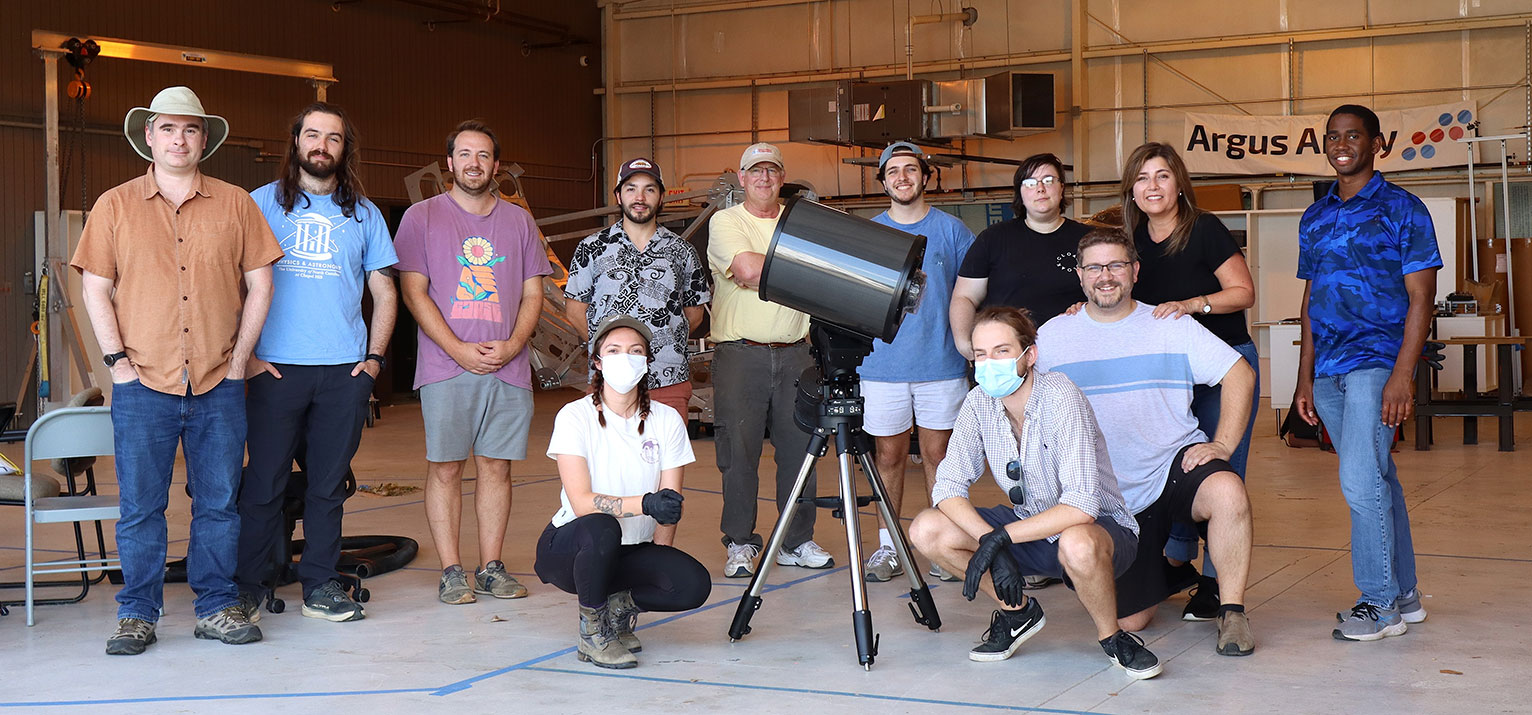
The Argus Array team
AI-powered discovery at extraordinary scale
Argus will generate data at a rate of 2,000 gigabits per second, making it one of the largest producers of scientific data in the world. To deal with this vast data rate, the system will rely on high-speed computing and machine-learning algorithms to analyze data as it is collected, selecting the most interesting events and sky locations for long-term storage.
AI-powered discovery engines developed at UNC-Chapel Hill will sift through the incoming stream in real time, flagging the most intriguing events for further study. Those discoveries will be shared rapidly with the global astronomical community, enabling follow-up observations using other ground- and space-based telescopes.
“Professor Law and his team embody our commitment, as the nation’s first public university, to pushing the boundaries of discovery while making knowledge accessible to the world,” said Lee H. Roberts, chancellor of UNC-Chapel Hill. “Now, thanks to a transformational investment from Schmidt Sciences and Alex Gerko, we’re taking the next giant leap in the world’s capabilities to detect cosmic events. We could not be more grateful for their commitment to pushing the boundaries of scientific discovery.”
Advancing science — and access
In addition to its scientific impact, Argus will serve as a cornerstone for open data in astronomy. The project will conduct the deepest and fastest survey of the entire Northern sky to date, and the full dataset will be made publicly available — rapidly and completely.
That commitment positions Carolina at the center of a global data repository that students, researchers and educators around the world will use to explore the universe and train the next generation of scientists. A rapidly growing international team of researchers from more than two dozen institutions plans to use Argus data for scientific research, education and public engagement.
“Argus exemplifies how the College of Arts and Sciences is leading at the intersection of AI, data and discovery. By combining a revolutionary telescope design and open access to an unprecedented volume of data, Carolina is creating a powerful platform for cutting-edge research that will transform astronomy and train the next generation of scientists,” said Jim White, Craver Family Dean of the College of Arts and Sciences. “I am grateful for the leadership of Professor Law and for this generous commitment from Schmidt Sciences and Alex Gerko to help bring Argus Array to life.”
Law and his group have been building sky survey systems for over a decade, with deployed systems in the Appalachians, California and Chile. Argus builds on this established leadership in astronomy, complementing existing facilities such as the UNC SOAR Telescope in the Andes and the SkyNet robotic telescope network. Together, these resources form a world-leading ecosystem for discovering and understanding rapidly changing cosmic phenomena.
The Argus Array is designed, constructed and operated by the Law group at UNC-Chapel Hill. Law is the principal investigator, Hank Corbett is the survey scientist and software lead, and Alan Vasquez Soto is the program manager and systems engineering lead.
“Argus is being designed and built by a team of graduate students, postdoctoral researchers, staff and engineers at Chapel Hill, along with our engineering partners across the U.S. A lot of what makes this telescope work didn’t exist when we started. Now it does, and we can’t wait to bring Argus data to the world,” said Law.
The Argus Array in the College of Arts and Sciences underscores Carolina’s role as a hub for innovation at the intersection of science, engineering and artificial intelligence — and its commitment to expanding humanity’s view of the universe.
Written by Meredith Tunney, College of Arts and Sciences
Images courtesy of the Law Group
Related Stories