We see that every day. From finding new cures to providing new scholarships, at Carolina we know that the best is yet to come. And we hope you see it, too.
This site is a resource and playground. It is a place where you can learn about some of the incredible stories that happen here. Or perhaps you have a story to share? Help us create this site by sharing something bold, innovative or inspirational that you experienced at Carolina, particularly because a private donation made it possible. Anything is possible here, but it isn’t free. Thankfully we have generous donors who see the potential and help make it happen.
We know there are many more to tell, maybe even yours.
We want to hear them. We need your help to collect them.
Click here to share your stories or the ones you’ve heard. This is your site, so help us fill it with all the ways Carolina is making a difference in the world.
Send Us Your Story
Have a good story about the power of private giving at Carolina? Send it to us! A short summary is fine, or a complete article or a link to one.
Subscribe To Carolina Stories
Modal content could not be loaded.
Eyes on the brain
Published on February 9, 2026
A Carolina alumna became the co-founder and CEO of a wearable technology startup at just 22 years old. She and her former research mentors are developing wearable smart glasses that could one day support new insights into mental health.
A western North Carolina native, Ellora McTaggart, admits she has a habit of seeking experiences that offer the greatest learning opportunity. That drive led her to the NC School of Science and Mathematics and the joint biomedical engineering program at UNC-Chapel Hill and NC State University, where she leaned into curiosity and complex problem-solving.
During her sophomore year at UNC-Chapel Hill, McTaggart was diagnosed with attention-deficit/hyperactivity disorder (ADHD).
“My diagnosis helped me understand my experience,” McTaggart said. “For years, I felt like I had to work harder than everyone else while being evaluated by a system that did not match how my brain works.”
Today, as the co-founder of a new biotech startup called Carolina Instruments, she hopes to help others identify and understand their needs sooner.
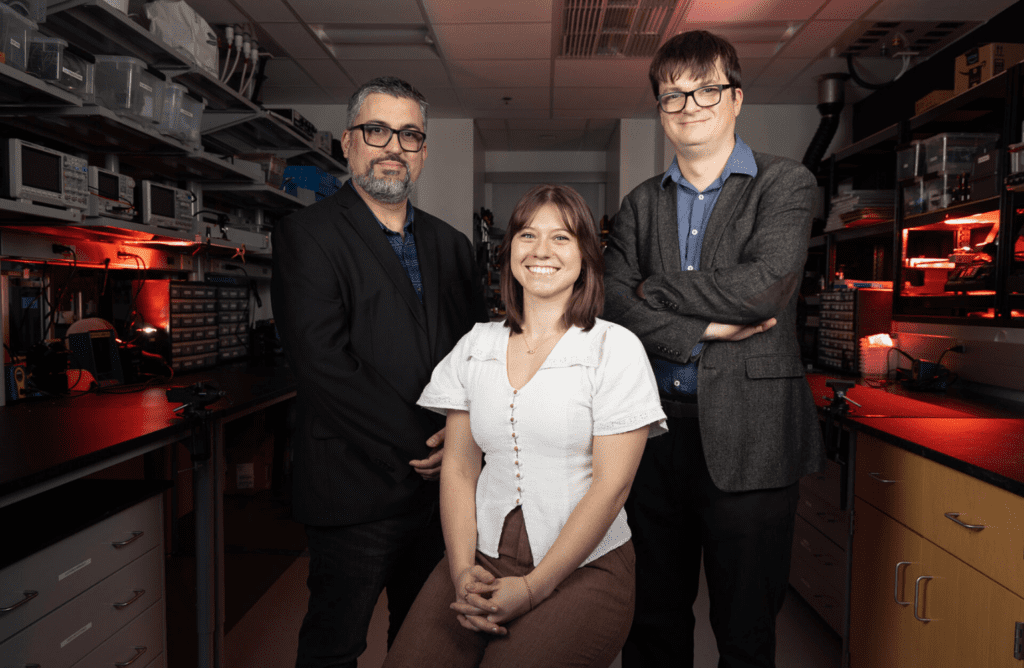
In her junior year, McTaggart began working with Carolina professors Nicolas Pégard and Jose Rodríguez-Romaguera to help develop wearable biosensing glasses that offer insight into how people respond to the world around them.
Watch how Nicolas Pégard and other UNC-Chapel Hill scientists are harnessing mouse biomarkers through custom technology that could transform the study of neuropsychotic disorders with support from the Arnold and Mabel Beckman Foundation.
The latest prototype looks like an ordinary pair of black-rimmed glasses, aside from a few pieces of metallic hardware along the bridge and inside the frames. This unassuming device is an eye-tracker that combines biomedical engineering and neuroscience to support research into the neural networks that regulate human behavior.
Unlike traditional eye‑trackers that rely on cameras and video processing, these glasses use Pupil‑Light technology — a compact, camera‑free system that detects subtle changes in pupil size and eye movement by converting light signals directly into measurements.
“The eyes give us a window into how people experience the world,” McTaggart said. “My hope is that making pupil measurements more accessible will add context beyond performance-based assessments, which often don’t tell the full story.”
In August 2024, McTaggart, Pégard and Rodríguez‑Romaguera founded Carolina Instruments to advance this technology for translational research and wider commercial applications.
Seeing an opportunity
Traditionally, scientists study neuropsychiatric conditions such as ADHD, depression, anxiety, or post-traumatic stress disorder (PTSD) by observing visible changes in behavior. But shifts in pupil size and eye motion often appear first.
As people enter heightened or reduced states of arousal — alertness, readiness or excitement — their pupils respond in ways that reflect neuronal signaling in key brain regions. These signals can shape behavior before it becomes outwardly apparent.
The long-term vision is that people could put on the glasses to capture subtle changes in their pupil size and eye motion patterns — information that could have meaningful implications for mental health research.
“My dream as a mental health scientist is to have an actual impact in the clinic,” Rodríguez-Romaguera said. “The minute I realized we had a device that could potentially do that, I knew we needed to explore the commercial side in parallel to our scientific pursuits.”
McTaggart first heard about Pupil-Light technology during her sophomore year, when Pégard gave a guest lecture to her class on optical engineering and holographic design. Enthralled by his research, she approached him after his talk and the two discussed his broader work.
Pégard partnered with Rodríguez-Romaguera to develop the pupil-tracking technology, with the goal of translating it into a wearable device. McTaggart immediately recognized its potential. As a biomedical engineering student, she was drawn to the idea of building a tool that could advance the understanding of the human brain.
Taking the lead
McTaggart began working methodically toward turning Carolina Instruments into a viable company, immersing herself in the world of startups and industry. She developed a business plan to license the Pupil-Light IP from the university and initiated deeper conversations with Pégard and Rodríguez-Romaguera about what they would need to succeed.
UNC-Chapel Hill proved instrumental in the company’s early success. McTaggart turned to KickStart Venture Services at Innovate Carolina, which helps student and faculty innovators create companies built on university research.
Through Kickstart, she participated in industry workshops, received grants to support early commercialization efforts, and validated customer interest. The program also connected her with an advisory group of more than 40 medical technology specialists, investors, and serial entrepreneurs who helped her sharpen the company’s pitch and strategy.
“Beyond the direct support, tapping us into the academic entrepreneurship ecosystem has been incredibly valuable,” McTaggart said. “We have some unique challenges as a university spinout and KickStart has helped us navigate them.”
Looking toward the future
The team recently secured their largest grant to date: a $400,000 Small Business Technology Transfer grant from the National Institutes of Health, led by McTaggart as principal investigator. This funding will support further development of the device’s animal model for translational research customers, informing continued progress on the human version of the technology.