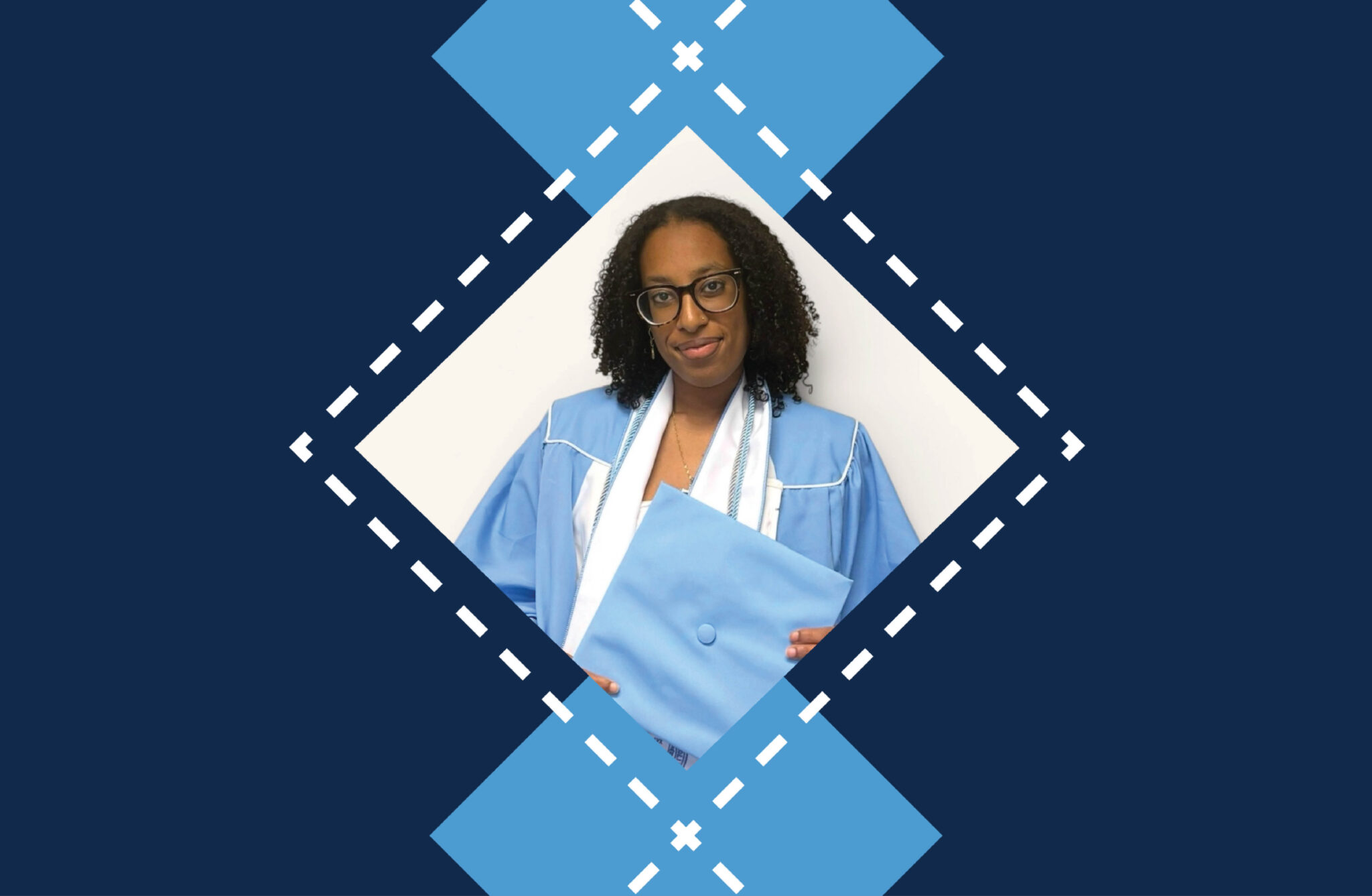
Caroline Robinson stands outside the FedEx Global Education Center where she attended class four times a week the same semester she underwent chemotherapy treatment at UNC Health (Photo by Johnny Andrews, University Communications and Marketing).
Caroline Robinson ’26, a former AYA Cancer Program patient and current senior at the UNC School of Nursing, reflects on her sophomore year at Carolina when an unexpected diagnosis abruptly shifted her life.
Written by Kate Slate, University Development
A new chair for the family living room, new sheets for her childhood bed and a semester in Ireland were mandatory precursors to Caroline Robinson’s spring semester as a junior at Carolina. On her head remained a wig and, on her chest, the scar from a port. Both traveled with her to Ireland and reminded her of how she’d spent the last six months of her life.
“Please tell me this hurts,” Caroline Robinson’s mother, a physician, pleaded as she pressed a lump on her daughter’s neck back in 2023. Caroline had just started the spring semester of her sophomore year at Carolina and was visiting her parents in Cary, North Carolina. Her necklace hung oddly against her chest. “No, I don’t feel anything,” Caroline replied. Four days later on March 1, she got her first dose of chemotherapy.
The lump on Caroline’s neck was Hodgkin lymphoma. Though highly treatable, Caroline’s diagnosis abruptly shifted how the next six months of her life would look. She went from being a college student to someone people cavalierly called a warrior, merely because her health diagnosis was cancer.
“I thought how people talked about cancer versus any other disease was very distinct,” said Caroline. “This had nothing to do with me. It’s my body against myself, and how hard I fight has nothing to do with it. So that was a bit of a transition.”
Caroline spent the days following her diagnosis in her childhood bedroom. She broke down and repeatedly asked herself, “Why me?” — because who is diagnosed with cancer when they’re only 20 years old?
The infusion chair
Caroline’s first round of chemotherapy went without a hitch. She slept well the night that followed and felt amazing the day after. “People complain about this?” she asked herself. In the rounds to follow, the side effects became unbearable. Her third dose brought fever-like symptoms — muscle aches, cramping and shivers — and landed her in the emergency room. At one point, her heart rate was 160 beats per minute while sitting down. Moving forward, Caroline would take Benadryl and Zofran prior to infusions, and steroids after, to ward off the shock-like state she’d otherwise find herself in again.
Managing her symptoms became all-consuming. She’d get to the hospital at 8 a.m. every other Friday and not leave until almost 5 p.m. Once she got home, her parents would inject steroids every six hours until they could stop on Sunday.
To further complicate an already difficult season of life, Caroline’s diagnosis came two months short of summer break. She decided to finish the semester despite a demanding courseload that included medical microbiology and anatomy and physiology — prerequisites to the nursing degree she is now completing. A rigid schedule ensued. Monday through Thursday she’d attend class in-person when possible and ask for recordings or a Zoom link when not. Every other Friday was reserved for her day-long infusions. When possible, she’d schedule exams to be taken the Monday through Thursday leading up to an infusion, as it would usually take her a week to recover after. Against all odds, she ended the semester with a 4.0 GPA.
Adolescent and young adult cancer patients
Unique to Caroline’s experience was the point in time the diagnosis reached her. Having cancer in early adulthood warrants conversations someone in pediatric or adult care might not readily receive.
To address this gap, the Be Loud! Sophie Foundation, in partnership with the UNC Lineberger Comprehensive Cancer Center, launched the Adolescent and Young Adult (AYA) Cancer Program at UNC Health in 2015. The program works to ensure patients aged 13 to 39 years old receive developmentally appropriate care.
“There just hasn’t been, historically, a model of care that specifically calls out the unique needs of adolescents and young adults who are sort of caught between pediatric and adult medicine models,” said Dr. Andrew Smitherman, a pediatric hematologist and oncologist at UNC Health who also serves as medical director of the AYA Cancer Program.
One of those unique needs is fertility considerations. Dr. Jake Stein, a medical oncologist at UNC Health and the AYA Cancer Program’s oncology liaison, explained how radiation and chemotherapy affect ovarian tissue and sperm cells that, overtime, can make people infertile.
“The first and by far most important thing is just to have the conversation,” said Stein. “But if nobody sits down and just says, ‘There is a chance that you will not be able to have kids in the future, and there are some options that we can do to address that,’ then we’ve taken that choice out of the patient’s hands.”
In Caroline’s case, she received a Lupron injection once a month to help protect her eggs. The medication, however, came with menopause-like symptoms. She’d wake up in the middle of the night in soaked sheets as if she’d jumped straight from a pool into her bed. It was no different at school.
“I’d be sitting in class and get a hot flash. My entire face would be bright red,” said Caroline. “I had those little stamp-on eyebrows to make it look like I still had them — well, the sweat would wipe them right off.”
Another patient of the program, 24-year-old Kassidy H., had an egg retrieval performed to preserve her fertility. This was made possible by the AYA Cancer Program team, through teaching fertility options available, providing emotional support and helping find financial sponsorships to relieve the financial burden. Kassidy was born with a sub-type of familial adenomatous polyposis (FAP), Gardner syndrome. The rare genetic syndrome predisposes her to colorectal cancer and causes numerous colorectal polyps, desmoid tumors, epidermoid cysts and other manifestations throughout her body. Most of her care has been preventative, involving routine scans, ultrasounds and tumor removal to manage disease progression. Since having a proctocolectomy in 2022 to prevent colorectal cancer, her tumor burden has increased and is managed through chemotherapy.
Kassidy has been in and out of the hospital 373 days since June 2022, with most of that time being in the last two years. “The AYA team has been a huge blessing to me and my care. Navigating this without them and their support would be really challenging,” said Kassidy.
In addition to thinking about fertility, adolescents and young adults with cancer face unique financial challenges. As Kassidy approaches 25 and works to complete her nursing and child life specialist degree in college, she’s had to think through how to pay for her health care in years to come. Between going to doctor’s appointments, finishing college and managing an unpredictable chronic illness, entering the workforce will be more challenging for her. Kassidy remains hopeful and continues to commute weekly from North Carolina to college in Virginia and to UNC Health for care.
Circumstances such as Kassidy’s have helped the AYA Cancer Program understand what kind of support patients like her need while transitioning through this stage of life. Furthermore, it’s informed plans for the program’s future.
The program’s team, in addition to Be Loud! Sophie Foundation co-founders Lucy ’88 and Niklaus Steiner ’88, want to bring the same care afforded to patients in Chapel Hill to lesser-served regions of the state and nation.
“We are so fortunate here at UNC, but we recognize not everybody has that,” said Stein. “So how can we build support and develop interventions so the same level of care we give here at UNC can be provided at centers across the state and country?”
New places
Caroline had her last chemo infusion on Sept. 1, 2023. She then studied abroad in Ireland the spring semester to follow, wanting to escape the shadow that was her last six months. Her eyebrows grew back, and lashes started to frame her eyes once more. Upon returning to Chapel Hill, she shed the final reminders of her time as a cancer patient: the living room chair where her parents administered steroid injections and the bedroom sheets she had sweated through.
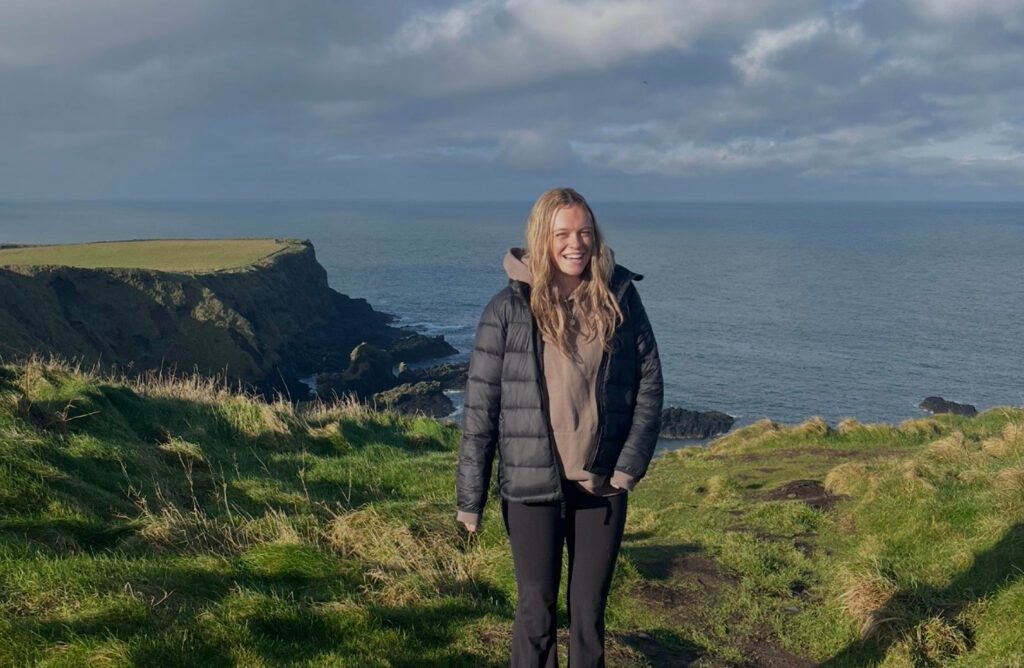
Caroline Robinson during her semester abroad in Ireland (Photo submitted by subject)
Caroline will graduate in May 2026 with a degree in nursing. She enters the career path with an acute understanding of patient needs from a time as a patient herself.
“I wouldn’t say if I could do it all over again, what I went through is what I’d want,” said Caroline. “But I’m so grateful now for the experience that I did have and the way it’s connected me to a whole community that I would’ve never even been able to understand or really be involved with.”
The AYA Cancer Program at UNC Health launched in 2015 thanks to the support of the Be Loud! Sophie Foundation and the UNC Lineberger Comprehensive Cancer Center. The late Sophie Steiner was a former patient of UNC Health, and her wish was for them to create a program that met the unique needs of adolescents and young adults undergoing cancer treatment. The Steiner family, including Sophie’s sisters, Elsa ’18 and Annabel ’24, and the AYA program are bringing that wish to fruition.
Related Stories