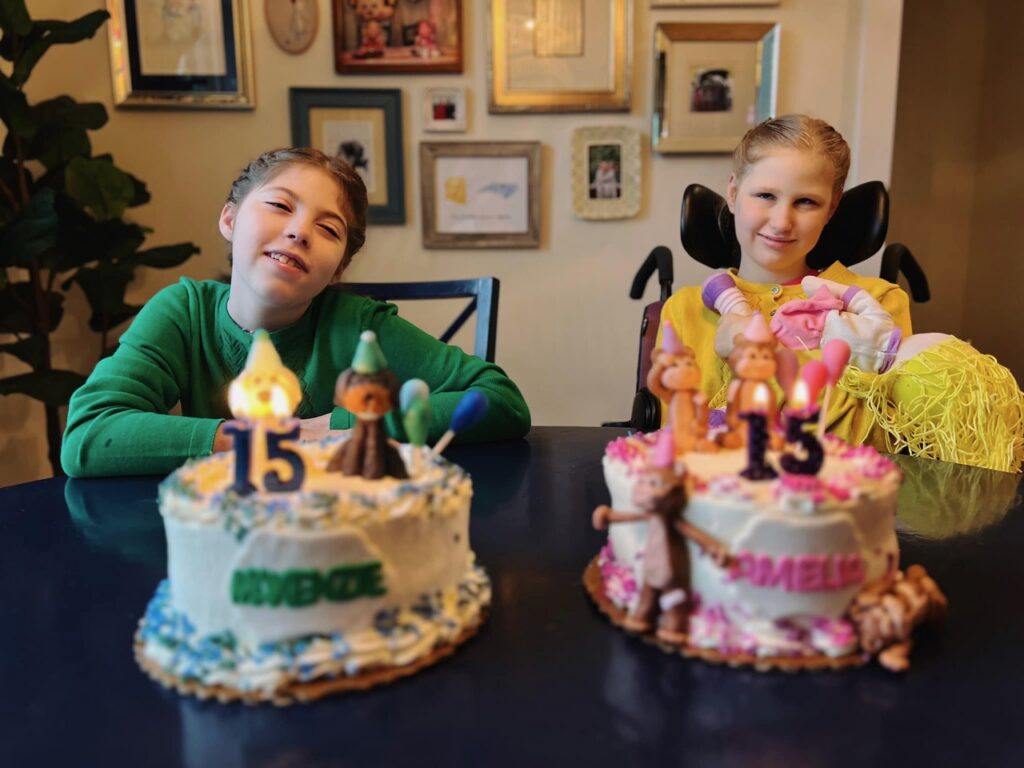
Amelia (right) and Makenzie (left) Kahn celebrate their 15th birthday.
Written by Kate Slate, University Development
Turning 16 for most is marked by familiar milestones – swapping bicycle helmets for car keys, taking practice drives around the neighborhood, and navigating the ebbs and flows of high school. For twins Amelia and Makenzie Kahn, turning 16 this March looks a bit different but comes with its own milestones the family didn’t expect to find.
The girls’ story begins in Phoenix, where they spent their formative years alongside their parents, David and Karen Kahn. Childhood, as documented through home videos, appeared typical: hula-hooping in the backyard, having water balloon fights and playing with their beloved dog, Pongo. Over time though, these everyday endeavors became challenging.
As the girls grew into their elementary school years, Amelia’s teachers said she was having trouble reading the board in class. Years prior at 18 months old, she was diagnosed with autism. The diagnosis, however, didn’t account for the vision loss she started to experience.
Despite numerous visits to various eye doctors, from optometrists to retina specialists, David and Karen were continually told Amelia had 20/20 vision. By happenstance, one retina specialist had experience with Batten disease, a rare and fatal genetic condition that affects only three out of 100,000 children in the United States. One of the first symptoms patients present with? Vision loss.
As David and Karen tried to understand Amelia’s challenges, her sister Makenzie was developing in a typical manner. While genetic testing was in progress for Amelia, they soon learned Makenzie needed testing, as well.
“[Makenzie] was reading a book, and it had yellow letters on a red page,” said Karen. “We were just flipping through, and she told me there were no words on the page.”
Before receiving the results, the Kahns knew what they were dealing with.
Grappling with a Batten diagnosis
In 2017, a month before Amelia and Makenzie’s seventh birthday, the girls were officially diagnosed with Batten disease. The rare neurological disorder is fatal, causing victims’ nervous system to break down over time. As the disease progresses, victims deal with vision loss, seizures and a decline in motor functioning. Provided there is no cure for the disease, care is focused on treating its symptoms rather than the disease itself.
In the years following their daughters’ diagnosis, David and Karen mobilized to help their daughters through an unforgiving disease. They formed the ForeBatten Foundation, an organization focused on spreading awareness and funding research for the rare disease.
To Chapel Hill
As the twins approached middle school and their condition worsened, David and Karen knew they had to make a few changes: They needed a more accessible house, to be closer to family since they could no longer travel, and a new environment free of such a harrowing past.
“We lived in an amazing family-friendly neighborhood, but as our family was declining, we were constantly reminded that our family was declining,” said David. “I couldn’t be surrounded by that anymore.”
They landed on Chapel Hill for several reasons, one of which was the ability of a university health system to take on their daughters’ care. The goal – at Phoenix Children’s, where the girls were previously treated, and at UNC – had always been to manage Amelia and Makenzie’s symptoms. Gene therapy, which the Kahns banked on for some time, was not an option for the twins’ specific mutation.
Shortly after moving to Chapel Hill, their care team took on a much larger role in this goal: housing a personalized clinical trial to slow the disease’s progression. Under the purview of Dr. Yael Shiloh-Malawsky, a pediatric neurologist at UNC Health, Amelia and Makenzie are participating in a personalized clinical trial that hopes to slow the disease’s progression. Zebronkysen, a drug developed by Michelle Hastings, PhD, a pharmacology and medicinal chemistry professor at the University of Michigan, is at the center of the trial that works to mask the girls’ affected genes, Dr. Shiloh-Malawsky explained.
“Remember old-school Christmas lights? When one bulb went out, the entire strand went dark. Now if one bulb goes out, just that one light is out — the rest stay lit,” said Karen. “That’s essentially what this therapy does. It helps the gene skip over the broken part so it can still work… even if not perfectly.”
Amelia and Makenzie received their first dose in June 2024 and continue to receive the treatment once every three months.
The treatment has come with unexpected victories for the Kahn family. David and Karen have borne witness to their daughters’ decline for almost a decade. Their treatment was never designed to improve their condition, only to stop further progression. Since receiving Zebronkysen, Amelia and Makenzie have benefited from certain improvements. Makenzie’s bouts of dystonia, a movement disorder causing involuntary muscle movement, have historically caused her to lean sideways while horseback riding, requiring a spotter to provide her support. Since receiving the treatment, she’s been able to sit upright without a spotter’s help. Amelia, who hasn’t taken food by mouth in years, has come to nibble on ice cream.
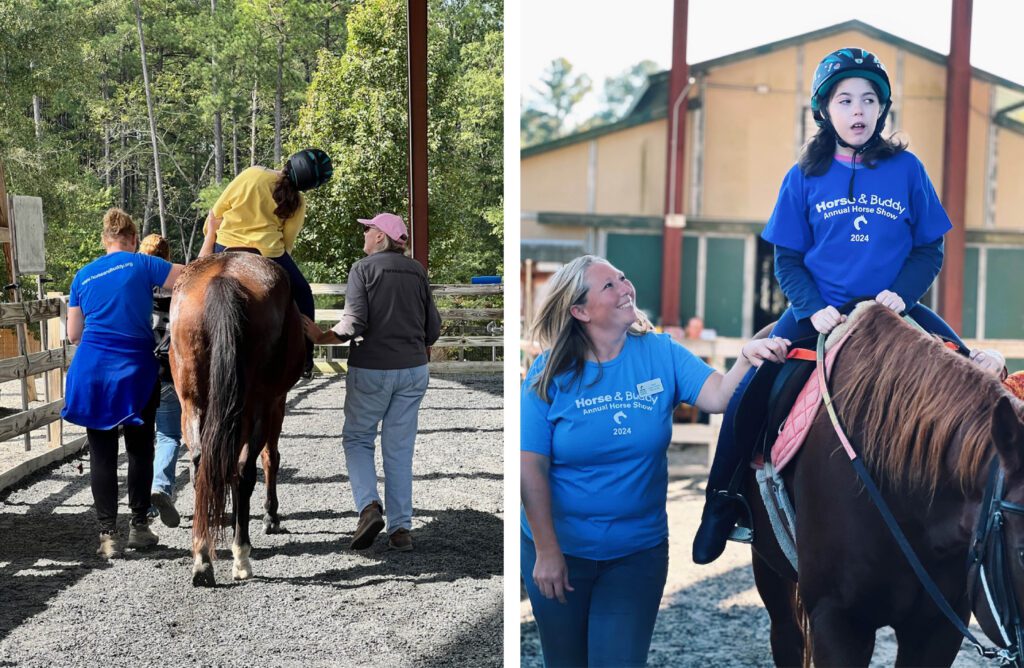
Makenzie horseback riding prior to (left) and while (right) undergoing treatment.
These little wins bring the Kahn family and Dr. Shiloh-Malawsky hope for the research underway, giving the family something to celebrate.
Turning 16
Each holiday that passes is bittersweet for the Kahn family. While they’re grateful for time with their daughters, Christmas, Thanksgiving and birthdays mark their harsh reality.
“Birthdays aren’t necessarily a celebration for us,” said Karen. “Holidays are just this point in time when you can look back to what they’ve lost each year.”
The disease has led to the girls’ complete vision loss; they rely on sound for sensory cues. Amelia and Makenzie are especially sensitive to overwhelming surroundings. Dr. Shiloh-Malawsky recounted a text she received from Karen this past year after Karen celebrated her own birthday. Zebronkysen helped make the moment worth cherishing:
“For the first time in years, the girls were able to go to a restaurant and sit in a room that had a lot of people and noise,” said Dr. Shiloh-Malawsky, adding it was something that had become impossible for the family to do. “So [Karen] texted us and said, ‘I couldn’t have hoped for a better birthday present.'”
In celebration of Amelia and Makenzie’s sweet 16, the ForeBatten Foundation is hosting an online auction to raise money for research. The foundation’s fundraising efforts have helped fund the n-of-2 clinical trial at UNC Health run by Dr. Shiloh Malawsky almost entirely. Zebronkysen is one of the first individually designed antisense oligonucleotides (ASOs) ever to enter a clinical trial. Results from the trial will help expand treatment for others with Batten disease. The generosity of external organizations and supporters helps bring pioneering methods of patient care, such as this trial, to Carolina and beyond.
Related Stories