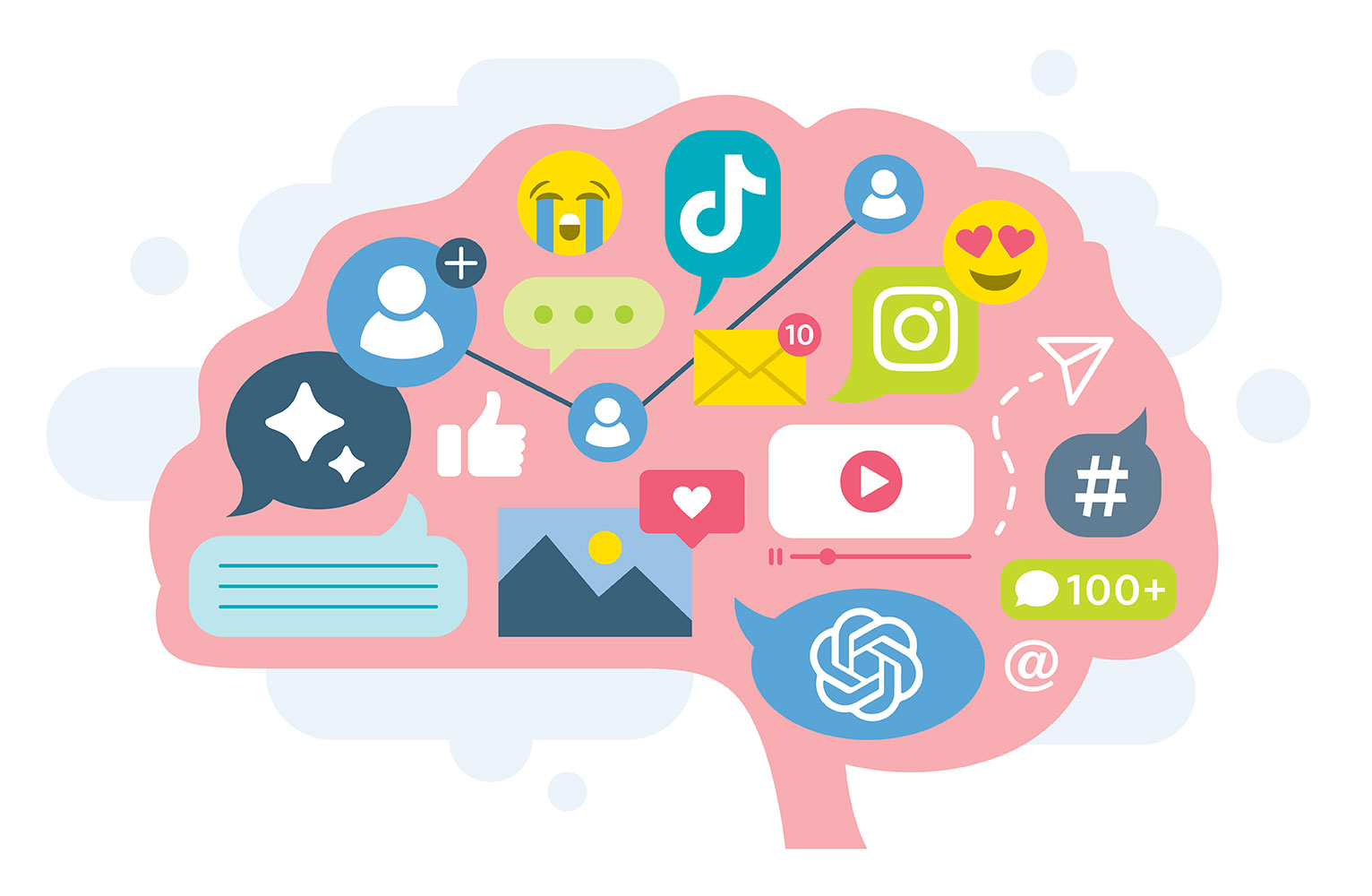
Human Change Foundation fuels research dissemination on technology and the developing mind through UNC-Chapel Hill’s Winston Center on Technology and Brain Development.
At a time when children are growing up with screens in their hands and algorithms shaping their identities, the UNC Winston Center on Technology and Brain Development’s mission — to improve youths’ well-being in a digital world — has never been more critical.
Now, thanks to support from the Human Change Foundation, the center’s research will be more broadly disseminated through channels that ensure parents are getting the most up-to-date information and advice for their children’s healthy development.
The Winston Center is a leading hub for interdisciplinary research, bringing together experts in psychology, neuroscience, education, data science and public policy to translate science into meaningful action. Mitch Prinstein and Eva Telzer, the center’s academic co-directors, have testified at the U.S. Senate and within several state legislative offices. They’ve worked with federal agencies to help communicate the science on technology development and with schools that applied phone restrictions to investigate the impacts in the classroom. Watch Mitch Prinstein on “60 Minutes.”
The Human Change Foundation’s work is protecting children against a digitalized childhood. By convening and connecting leading experts across disciplines to break down silos, the foundation works as a catalyst to address the effects of digitalization on children’s mental health and development. Founded and chaired by Margarita Louis-Dreyfus, the Human Change Foundation fosters collaboration and knowledge exchange at global, high-profile events, such as the World Economic Forum in Davos, Switzerland, where Dreyfus hosts the “Human Change House.” Prinstein and the Winston Center’s founder, Jim Winston, have been featured speakers at past Human Change events, and will attend again in January 2026.
“Our children deserve to grow up in environments that strengthen their emotional, social and cognitive development — not ones undermined by excessive digital exposure,” said Louis-Dreyfus. “The Winston Center’s research is transforming our understanding of how digital devices can shape the developing brain. We are proud to support this vital work as it paves the way for new approaches that safeguard children’s development and help secure a healthier future for the next generation.”
From smart phones to toys built with AI-enabled companions, the use of these devices can shape children and adolescents’ neurological development in ways parents might never imagine. To help families navigate this landscape, the Winston Center has compiled research discoveries that shed light on how technology can affect emotional health, learning, sleep, social connection and more.
5 findings parents should know
- Heavy social media use in early adolescence changes brain development, leading youth to become hypersensitive to social feedback and less likely to exert self-control. Researchers found that kids who used social media heavily in sixth grade showed unusual brain changes over the next few years. Instead of developing stronger “brakes” to control impulses — as is typical between ages 11 and 14 — their brains became more sensitive to social feedback and less able to regulate behavior, suggesting that early, frequent online engagement may disrupt healthy emotional development.
- Kids who use their phones in school get lower grades. Surprisingly, the same outcome occurs for the kids sitting behind them.
- Most teens are exposed to cyberhate online, which predicts increases in anxiety and depression not only among those targeted, but also among bystanders. Research shows that the nature of cyberhate online is even more damaging than the same behaviors offline, because posts are often anonymous and elevated through likes and comments.
- Digital stress is taking a toll. Nearly half of teens report this digital stress significantly interferes with their ability to complete daily routines, including hygiene, sleep and exercise. That stress predicts higher depression within a year.
- Teens are turning to AI companions over their parents. About 50-75% of teens use AI chatbots, and their “advice” has led to disastrous consequences for many teens and families. AI-enabled companions are now built within toys marketed toward youth between 0 and 6 years old.
3 tips for making smart choices
The Winston Center has done substantial work to help parents make evidence-based, smart choices about their children’s smart devices.
- Set screen limits for your children. Over 50% of kids can’t stop using social media even when they want to, and they report at least one clinical symptom of clinical dependence on social media, from withdrawal, tolerance or uncontrolled over-use. Many youths may initially object but later are grateful to their parents for using parental controls.
- Remove smart devices from the bedroom. Teens need 8-9 hours of sleep each night for healthy brain development. Fewer than half of U.S. ninth graders and one quarter of twelfth graders get sufficient sleep. Social media use is the most powerful predictor of delayed or disrupted sleep, which subsequently leads to less growth of white matter in adolescent brains. Youth (and adults) should leave their devices to charge overnight outside of the bedroom, especially on school nights.
- Talk with your children frequently about what they see online. The majority of teens are exposed to hateful, dangerous and illegal content online. Many are exposed to predators, and most are directed to sites that teach them how to engage in self-injury or eating disordered behaviors as well as how to hide those behaviors from their parents. Talk to your children about these topics before they get online, and if they are not ready to learn about these topics, they may not be ready for unsupervised use of social media.
“Technology is here to stay,” said Prinstein. “Our goal is to understand how people can get the most benefit from these new tools and avoid risks to academic, psychological, biological and social development.”
Thanks to the support of the Human Change Foundation, the Winston Center is even more equipped to tackle these issues and make their findings more publicly accessible.
About the Winston Center on Technology and Brain Development
The Winston Center at the University of North Carolina at Chapel Hill was founded through a generous gift from Jim Winston ’81, ’92 (Ph.D.) during the Campaign for Carolina. Today, it stands as a global leader in studying how digital technologies influence the developing brain. Its mission is to transform groundbreaking research into accessible education, empowering parents, educators and policymakers to foster healthier digital futures for young people. Learn more at winstoncenter.unc.edu.
About the Human Change Foundation
The Human Change Foundation is protecting children against a digitalized childhood. The foundation connects the world’s leading experts on children’s development and technology reform with decision-makers across business, politics and philanthropy to spark collaborations, encourage further research and galvanize a global cultural shift toward safeguarding children’s humanity. Through the power of knowledge exchange, education and collaboration, the Human Change Foundation contributes to a system of change to safeguard future societies from the harms of over-digitalization and unchecked generative AI development.
Written by Angela Harwood
Illustration by Christina Berkowitz
Related Stories