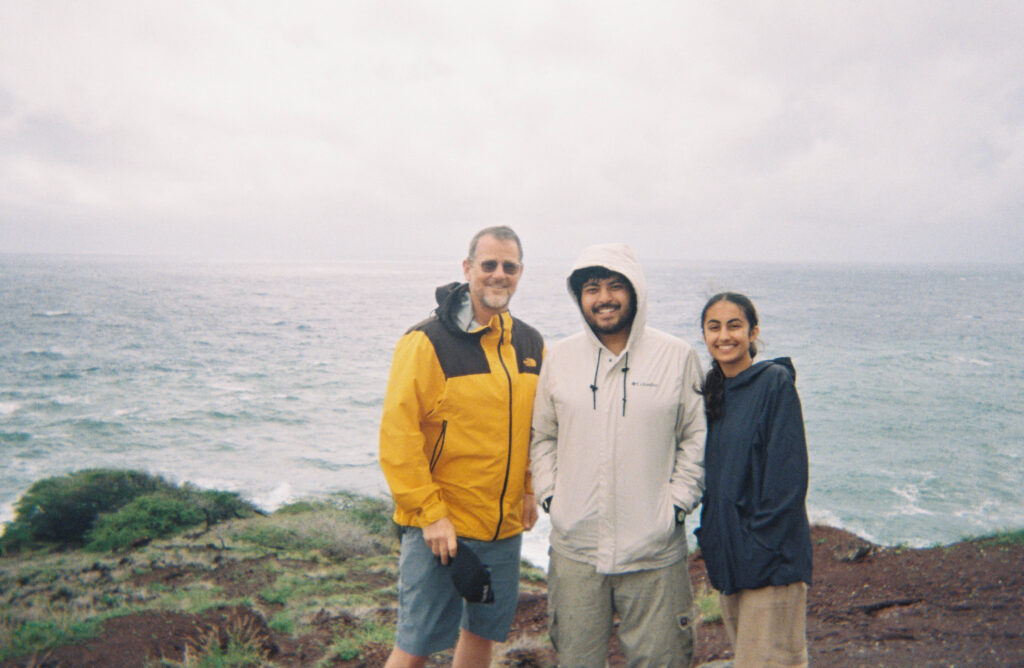
(Left to right) UNC Hussman Professor Patrick Davison and students Aayas Joshi and Keya Mahajan during an excursion in Hawaii. (Photo submitted by subject)
On August 8, 2023, one of the world’s deadliest wildfires ravaged Maui, with the western coast town of Lahaina bearing its brunt. Almost three years later, the town, which holds significant historical and cultural meaning, is still working to rebuild all that was lost.
Written by Kate Slate, University Development
Amid the bustle and stress of midterms, sophomore Keya Mahajan ’28 received an email last November that read: “Greetings! Congratulations on being selected as one of our reporters for the MEJO 584 international multimedia projects course…” With temperatures dropping and branches lying bare in Chapel Hill, it wasn’t difficult to say yes to what she had been offered: a spring break trip to Hawaii.
Keya, a double major in economics and media and journalism, spent 10 days in Maui this past March through MEJO 584: International Projects, a semester-long course offered by the UNC Hussman School of Journalism and Media. Though not an international location, the archipelago provided students with an experiential learning opportunity to explore the aftermath of the 2023 Hawaii wildfires. Most of the contiguous United States, or the “continent” as it’s called by Hawaiians, said Keya, has long since forgotten about the natural disaster and destruction that ensued.
“Our job was to go there and bring light to all the issues — housing, environmental and climate — that they’re still struggling with,” said Keya.
Experiencing Maui
Prior to landing in Maui, Keya’s team spent several months researching the wildfires, learning about the island’s rich history and connecting with sources who could offer native perspectives. Through emailing and cold calling, they practiced tricks of the trade and navigated speed bumps along the way.
“People are very kind and open [in Hawaii], but something we realized is they were hesitant due to the island’s colonial past,” said Keya. “Gaining and building that trust was a large part of our process in the first few months.”
Despite months of planning, students quickly learned a skill familiar to all journalists: how to pivot. When they arrived in Lahaina, Keya and her classmates were greeted by a Kona storm, which she described as a “mini hurricane.” The weather pattern is common to Hawaii, but during Keya’s trip it brought record levels of rainfall to the state, and in turn, uprooted her team’s plans.
Keya ended up working closely with a forest restoration nonprofit, Aloha Pu‘u Kukui, and community members to help understand the extent of the fires’ destruction. Keya and two other team members spent one day sporting contractor bags as ponchos and trudging through the mud to help Lahaina Strong, a community organization, clear debris from a recent flood. Working closely with subjects provided Keya and her team with invaluable conversations and experiences that contextualized the island’s challenges and resilience.
Developing journalists
Spending a semester working alongside other content producers offered Keya a glimpse into what a career in journalism could embody. Students in the class were divided into five teams, each comprising a reporter, designer and/or developer, photographer(s) and videographer(s). Each team covered a different sector of society. Keya’s team specifically examined how Lahaina’s climate was affected by the wildfires and how locals are rebuilding the community.
“I was so honored to be surrounded by such talented people who are so good at their individual niches,” said Keya. “I didn’t just learn something about being a better reporter, like a print journalist. I learned something about being a better videographer, a better photographer and a better designer.”
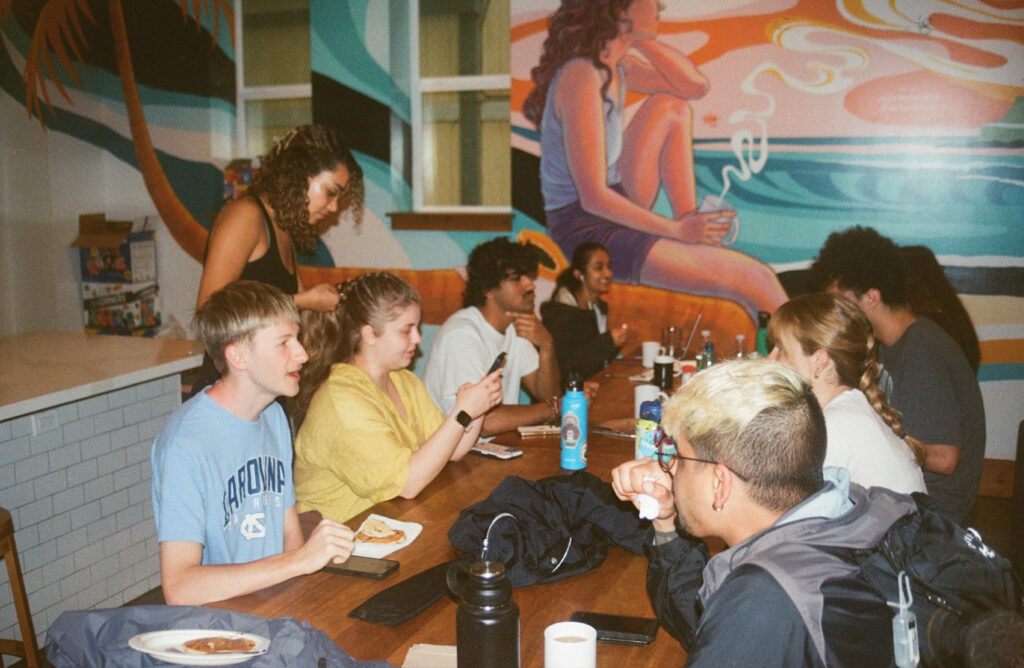 Students converse over an early morning breakfast at Howzit Hostels in Hawaii. Students woke between 5 and 7 a.m. to provide themselves enough time to get to their locations each day, which were often far away, said Keya. The hostel served pancakes each morning and made pancake art. One worker designed Rameses. (Photo submitted by subject)
Keya hopes to one day serve as an international correspondent for a legacy media company, stemming in part from her multicultural background. Both of Keya’s parents emigrated to the United States from India, leaving her caught between two identities for the better half of her childhood. In recent years and through this class, however, Keya has grown to understand how this identity empowers her storytelling capabilities. She credits her own heritage with allowing her to connect to native Hawaiians and their unique experiences on a deeper level.
“Doing this project made me realize how important it is to be a person of color in journalism. You approach life with an entirely different perspective because you have your parents’ culture, your family’s culture and your history behind you,” said Keya. “I think it’s important to bring that kind of diversity into journalism.”
A culminating documentary
The class held a screening of their semester-end documentary, “Mālama Maui: The Land We Hold,” this April at the FedEx Global Education Center. With a documentary to show for her semester of immersive work, Keya looks to the future and the career aspirations she hopes to pursue.
“My long-term goals align with international reporting. I want to travel, put myself out there and take time to see the world. This class is such an amazing opportunity provided by Hussman because it gives the kind of experience that most reporters never get a chance to do, especially in college,” said Keya. “I think journalism is the highest form of service, and that can be expensive. It’s important that the University continues to lend out a hand to the people who want to serve.”
Each spring, students in MEJO 584: International Projects travel to a global location and create a multimedia project covering the region’s economic, environmental and political landscape. To ensure all students have access to experiential opportunities, UNC Hussman offers the Global Immersive Fund — an endowed fund designated to support students in immersive programs and international courses. Keya received a partial scholarship that helped cover trip costs.
Related Stories