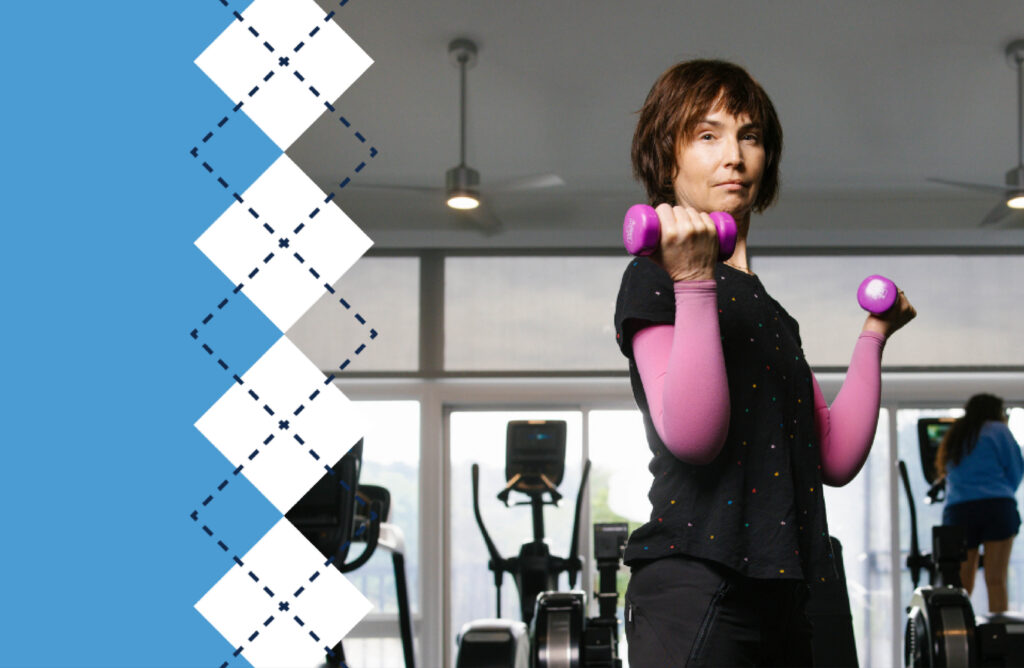
Eli Levene, a South Carolina native and Durham local, has spent the last 10 years battling breast cancer and side effects from treatment. The UNC Get Real and Heel program has helped retain her physical and mental resilience.
Written by Kate Slate with photos by Jeyhoun Allebaugh, University Development
In a treehouse-like structure at the Carolina Outdoor Education Center in Chapel Hill, Eli Levene starts her week. After sending her two kids, Jules and Hazel, off to school, she drives down U.S. 15-501 from her home in Durham until she’s reached UNC-Chapel Hill’s campus. Sometimes she steers the car herself, while other times when she can’t drive, she sits as a passenger. Levene rides down Country Club Road, passing the School of Government and School of Law, and turns right onto an almost imperceptible street. At the end of the drive sits a small gym up in the trees that houses Get Real and Heel: an exercise program for cancer patients like herself.
A decade-long journey
Starting her week among greenery and by breaking a sweat is a stark contrast from the many doctors’ offices and operating rooms Levene has seen over the past 10 years. When she was 42 years old, she was first diagnosed with breast cancer and underwent a mastectomy, chemotherapy and radiation on the affected breast. A year later, cancer was found in her other breast – a rare occurrence that took both Levene and her care team by surprise. After undergoing treatment once more, she learned the cancer had metastasized to her chest and brain. Through ongoing chemotherapy infusions and stereotactic radiosurgery (SRS) radiation, her team was able to remove the cancer completely.
The true cost of Levene’s diagnosis, in recent years, has come while being cancer free and undergoing regular infusions. Levene started suffering from radiation necrosis: a condition that can stem from intense radiation therapy and damage brain tissue. Among other side effects, the condition can cause significant fluid buildup. Since 2020, Levene has had seven brain surgeries performed to drain the fluid.
With each surgery has come a series of setbacks. Everyday tasks that were once innate to Levene – such as holding a cup of coffee at her favorite neighborhood café, Guglhupf, or driving to Whole Foods to get groceries – have had to be relearned through physical therapy.
“My coordination is off, my strength, everything because the brain controls so much,” said Levene. “It’s weird because I probably have the muscle ability because people can lift my arm, and I don’t feel any pain or struggle. I just can’t lift it myself.”
With each surgery, Levene would work for months to rebuild her strength through a combination of therapies. A recent component of that recovery – instrumental to both her physical and mental health – has been her participation in the Get Real and Heel exercise program at UNC-Chapel Hill.
Get Real and Heel
For 20 years, the Get Real and Heel exercise program has provided personalized fitness training to cancer patients throughout North Carolina, and in recent years, outside the state too.
“We know that it’s very important that people who have cancer move their bodies, if not for their physical health, for their emotional health, symptom management and preventing disease recurrence in the future,” said Program Director Carly Bailey. “So, we have this resource to help people do just that.”
The program started as a research study for women who completed treatment for early-stage breast cancer back in 2006. Since then, it has transformed into a 12-week free exercise program for patients with any cancer diagnosis, across a vast age range and at any stage of treatment. Participants train at least twice a week, working alongside the program’s exercise physiologists and cancer certified trainer on tailored workouts in-line with American College of Sports Medicine guidelines.
For Levene, this means venturing to the program’s gym at the start of each week to meet with Gabby Brennan, a clinical exercise physiologist, who takes her vitals. The pair, sometimes with the help of student volunteers, then cycle through an assortment of cardio, strength, balance and flexibility exercises, adjusting difficulty level as needed.
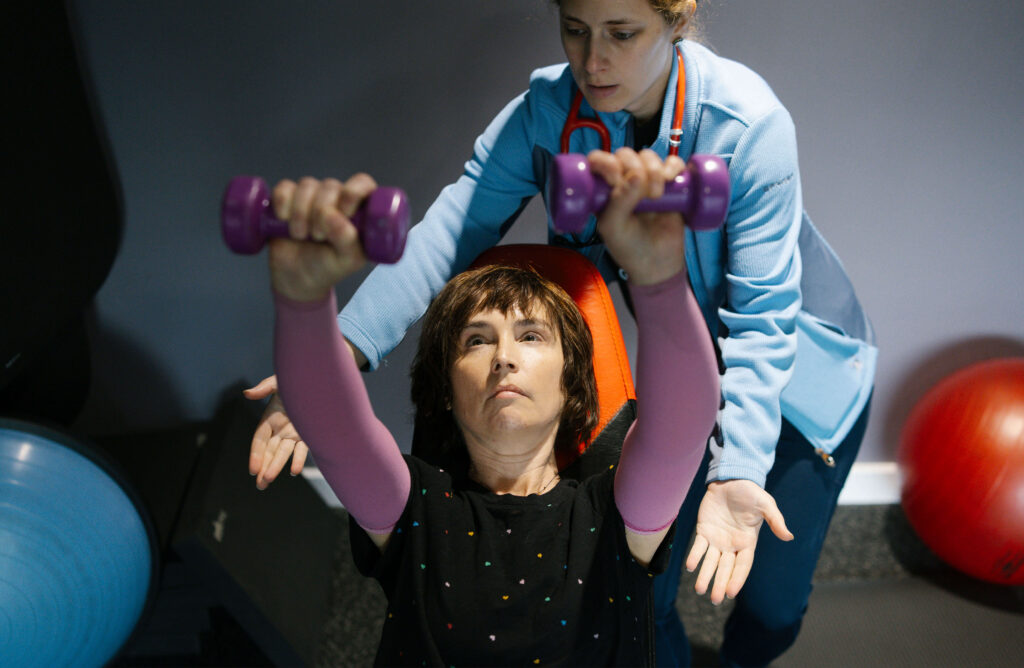 Eli Levene working out alongside Get Real and Heel exercise physiologist, Gabby Brennan.
“For each cancer diagnosis, there might be different things that we have to account for. If you have breast surgery, you’re probably going to do something different for exercise than if you have prostate surgery or an abdominal surgery. Some people don’t have surgeries, they might just have chemotherapy. Some people have ports…” said Brennan. “So it’s just being able to understand everyone’s background and make sure that we can adjust their exercise programming according to how they’re feeling.”
A community of shared experience
Having a program dedicated to the specific needs of cancer patients has been especially meaningful to Levene. Prior to her diagnosis, she enjoyed taking group fitness classes like yoga and high intensity training, but over time, entering these spaces became more challenging.
“When I was diagnosed, I still tried to do some classes. For me, it was hard going to a public class when I had a head scarf on and wasn’t feeling as great,” said Levene. “Even though teachers were understanding and nobody pushed me, there still wasn’t a community around full of other people who had been through this.”
Pinnacle to the Get Real and Heel program is inclusivity. In addition to curating a space for exercisers who have lived a shared experience, the program works to ensure participation is available to all, regardless of geographical or language barriers. Through a train-the-trainer model, the program has expanded to include nine sites across the state. They’ve additionally adapted for Spanish speakers and have specific programming, including a support group element, delivered only in Spanish. The team also provides virtual programming, which was especially useful for Levene when her driving was limited.
“We’re really trying to create a program where if you are a person who’s being treated for cancer, you have a way to exercise, whether that is in Chapel Hill at the mothership, online or at one of our partner sites” said Bailey.
For others, getting to exercise virtually has meant staying involved with the program even when they no longer reside in the area.
“We are really bad at kicking people out,” said Bailey. “So, we’ve created an off-ramp for people. On Fridays, our graduates can come back to our gym and work out with our trainers. It’s a little bit more hands-off, but still the workout is written for them and there’s somebody there to show them modifications if they need it.”
Levene’s participation in the program, technically, should come to an end this spring, but she hopes to continue participating.
“I’m just going to keep going until they tell me not to go anymore,” said Levene.
The program has helped her find the mind-body connection that had been missing since she was told she had cancer.
“When I learned I had breast cancer, it’s like my body had failed me. I was totally fine until some doctor told me I had cancer,” said Levene. “I think the Get Real and Heel program has helped me connect to my body again in this way that’s different, but so valuable.”
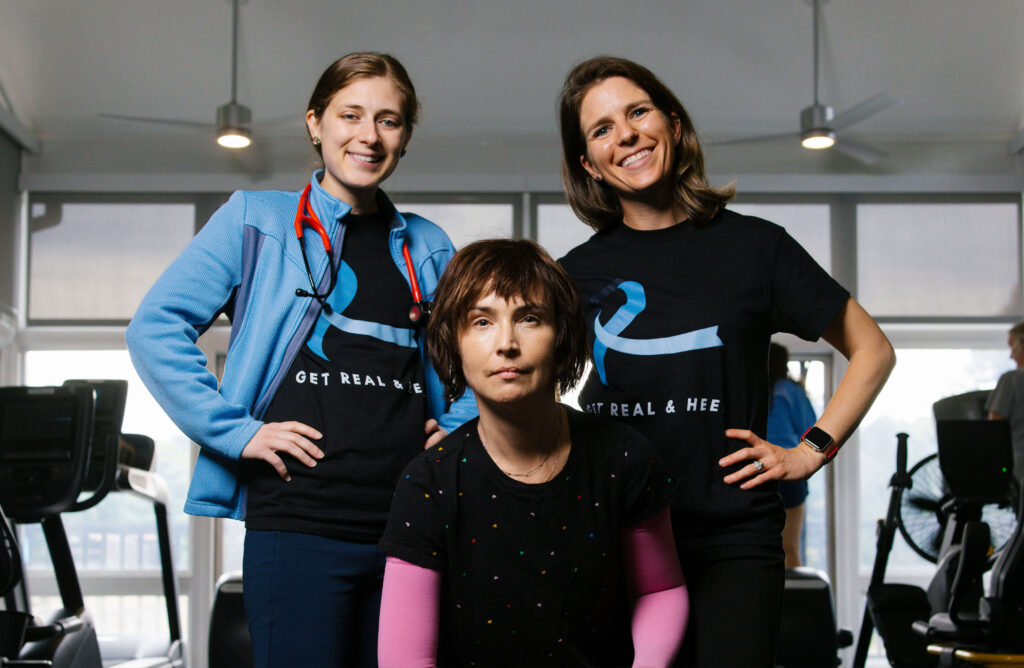 Eli Levene (center) with exercise physiologist and program coordinator Gabby Brennan (left) and program director Carly Bailey (right) at the Get Real and Heel gym.
The UNC Get Real and Heel exercise program is commemorating 20 years of offering personalized training to cancer patients at all stages of care. Through support from the UNC Lineberger Comprehensive Cancer Support Program, grants and private gifts, the program has been able to offer its services for free. To celebrate, the team is hosting The Wellness Exchange, a day-long wellness symposium where participants can learn from guest speakers and participate in art and writing therapy among other mindfulness-based activities. The Wellness Exchange is open to anyone wanting to learn more about wellness in the context of cancer.
Related Stories